Showing posts with label blogging. Show all posts

Wednesday, July 6, 2011

moved to tumblr!

This my 100th blog post.

(I feel like that statement should have some fanfare associated with it. Some streamers, a marching band, something. 100 posts is a lot of words, even for me.)

Today is also my birthday (true story, and no, I didn't plan it out this way). So, as a birthday present to me (can I even ask for a birthday present?), do me a favor and redirect your feeds, bookmarks, and the like over to:
http://thegapbetween.tumblr.com
I won't bore you with an analysis of why I decided to switch from Blogger to Tumblr (user interface, mobile capabilities, easy static page creation, a superawesome community, along with a personal desire to shake up my content a little bit and include shorter snippets as well as long posts), but I hope you'll take a look around the new site and tell me what you think.

I won't be using this domain any more for new posts, so mosey on over to Tumblr.

See y'all on the flip side!

Sunday, July 3, 2011

less designing products and more designing outcomes

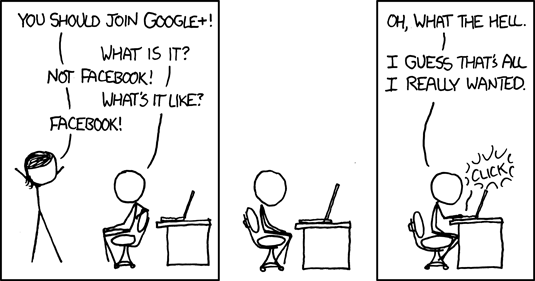
Thanks to Shalini, I started playing with Google+ this weekend. It's definitely interesting. I set up my Circles, checked out some Streams, tried to put in some Sparks (still haven't tried Hangouts - if you're on Plus and want to check it out with me, let me know!). My first thought mirrored the xkcd cartoon, "It's not facebook... but it's just like facebook!"

Rocky Agrawal wrote a great post about Circles yesterday. In particular:
The biggest unsolved problem in social networking remains unsolved with Google+: separating signal from noise. Twitter, it seems, doesn’t even want to try. The timeline is as dumb as it has been since the beginning, a reverse chron firehose of information. Facebook’s feed has improved over the years, but a friend in New Jersey trying to get rid of a bookshelf is just not relevant. 
The lack of quality tools for generating signal out of these feeds is inhibiting the creation of content. People are multidimensional and manual segmentation at the person level isn’t enough. I create content about a lot of things, including social networking, mobile, daily deals, my travel, my reading and more. But as I was reading Onward, I shared less than I would have because I didn’t want to flood people’s streams. If I annoy people, they have a blunt tool to fix it: unsubscribe entirely. So I mitigate my posting.
I'm a very selective content consumer, and an even more selective content creator. I blog, but I won't tweet. I'll post location on Instagram, but not on Facebook. When it comes to organizing my Reader feed or picking people to follow on Buzz or Tumblr, I'm merciless. And as a creator, my biggest concern is not about privacy (although I make it seem like it is). It's about irrelevance.

At the end of the day we don't need more creation and consumption tools. Everyone has their favorites - Facebook, Twitter, LinkedIn, Blogger, Wordpress, Digg, Disqus, Tumblr, Buzz, Flickr, and a thousand others that pop up every day. Right now, all it's doing is giving us more sites to check to get the content that's relevant to us. What's important is how we create value out of these things to generate a stream of content that's meaningful to us. And I'm hoping that as Google+ grows, it addresses the "signal-to-noise" problem that's overwhelming our lives.
The future for content sharing is bright, but the path to get there is still nebulous. Kind of like DTW.
A few months ago I had a great conversation with one of our national sales directors about creating products in healthcare. Healthcare is a great example of a market in which companies have focused on creating and selling products to solve problems. But what's valuable in healthcare is not products - it's outcomes. A subtle nuance, but important. Technology on its own is useless, unless it can drive the outcome - better health, less disease, higher quality of life - that we desire. The tool has to reflect the task.

Google has created a tool to drive its market share in social. It's created a product. But what social needs right now is not products. It's outcomes.

Consumption and creation are huge topics of interest for me. In fact, it was a conversation over seafood in Midtown about how we create and consume that led to this blog. At that time, it was Google Buzz that was new and exciting in social. Now, as I near my 100th post (we're up to 98, for those keeping score) more than a year later, I'm excited to see what Google+ does to the creation and consumption landscape.

Monday, February 28, 2011

a year of blog, a year of dog

Today is Sawra's first birthday.

It's also been exactly one year since I started this blog. Both experiences have brought me a long way, and have taught me things that I didn't know I needed to learn. For the 2,000-odd visits, emails, comments, and most importantly, conversations, surrounding this blog, I owe immeasurable gratitude to all of you.

Thank you.

And as for puppy, it's hard to describe in words the laughs, the joys, the exasperation, the frustration, and the love of raising your first puppy... so I'll do it in pictures instead :).

Meeting puppy for the first time. Three months old on Memorial Day weekend.
Things Sawra likes: style.
Things Sawra does not like: sunglasses.
Things Sawra likes: displacing me from my bed.
Things Sawra does not like: being displaced from my bed.
Things Sawra likes: clothes (albeit not for the same reasons that I do).
Things Sawra does not like: shoes (or rather, booties, in this case).
Things Sawra likes: Halloween.
Things Sawra does not like: Halloween costumes.
Things Sawra likes: chewing.
... and chewing...
... and chewing.
Things Sawra likes: Aunt Andrea (but then again, who doesn't?).
Things Sawra does not like: cold weather.
If you'd like to use any of these pictures, feel free, with credit.

Sawra is the Aramaic word for "hope." Here's to puppy and the hope of things yet to come.


Happy birthday, puppy!

Monday, September 20, 2010

tug of war & thoughts on 3rd year of medical school

An incredible post from an incredible friend.
Current location:Barnes Hospital/St. Louis Children's
Current mood:All
Current music:DMB: Christmas Song

Tug of War

I've never been more nervous or more excited about what's going to happen from day to day. I'm blessed to be on the path to the greatest profession I could possibly imagine.

The first time a patient calls you "Doctor," it's really cool and really scary. I am not, in fact, a doctor yet, but it's fun to pretend.

Sunday, September 19, 2010

to become a better writer, write

self-expression is a learned skill.
On August 1st, I stumbled across a website called 750words.com. I've always heard that to become a better writer, you need to write. And that by becoming a better writer, you become a better reader (of more, and more relevant, content). I thought, I'll give this a shot. 750 words = 3 pages, as it's explained:
Morning pages are three pages of writing done every day, typically encouraged to be in "long hand", typically done in the morning, that can be about anything and everything that comes into your head. It's about getting it all out of your head, and is not supposed to be edited or censored in any way. The idea is that if you can get in the habit of writing three pages a day, that it will help clear your mind and get the ideas flowing for the rest of the day.
For 48 days, I wrote religiously, almost exclusively in the morning, often before going for a run at 6 AM. Eventually, I got into a rhythm, writing first my personal mission statement verbatim, then letting myself run wild on my thoughts and reactions to where I was. Then I always concluded with a thought for the day, a goal, an inspiration. For 48 days, despite my travel schedule, availability of internet connection (or laptop!), meetings, appointments, and all the other craziness that the past few months have brought, I wrote no matter what, sometimes finishing the day's thoughts on my iPhone. I wanted to make sure I hit every date, could continue my "streak", meet my challenge. Some days were harder than others; some days more open, some with more thoughts to share. I expected to feel a surge of creativity, an undiscovered side of myself that would point me in a new direction. And above all, I wanted to check my box and say that I had done my time and completed the day's words.

And then yesterday, I woke up at 4 AM to a sick puppy. Sawra had vomited in her crate, and both her fur and her den needed cleaning. It wasn't a task I particularly felt like doing, especially on my day to sleep in after weeks of 5-AM-wakeups. So an hour later, as I pulled my laptop into the bed and opened up the site, my mind was as blank as the white space in front of me. I just didn't want to write.
my overall mindset in all my time at 750words.
Creativity can't be forced. Creativity isn't about checking the box, about scoring points when you write just to write. There is a lot of value in pushing yourself through things that most people won't (link is a .pdf), even when you don't want to. But there is more value in realizing when you need to do that... and when you don't. I've learned a lot by waking up every morning and writing 3 pages. One of the things that I've learned, is that sometimes you have to let yourself deviate from the schedule you've set. That your idea of what should happen in your life, and when it should happen, isn't always the way that it will happen. And you have to be ok with that.

I've learned that you don't always learn what you think you're going to. I've learned that I write very quickly, that my thoughts center on religion and success. I learned that I am consistently and privately introverted (and, although many of you won't believe me, that my extrovertedness is a learned skill). I learned that I am unfailingly positive, more certain of myself than most of the world, and toeing the line between thinking and feeling. I am learning that I filter my words unconsciously, that I'm not often completely open with the thoughts in my head, and that to be self-expressive is difficult for me (which makes blogging scary, at times). I've learned that despite my background in design and engineering, my creativity has always been primarily in words, and that I have an uncanny ability to describe every situation in life through song lyrics (and am I reminded now of the Anna Nalick song "Breathe"):
two am and i'm still awake writing a song
if i get it all down on paper it's no longer inside of me,
threatening the life it belongs to
and i feel like i'm naked in front of the crowd
cause these words are my diary, screaming out loud
and i know that you'll use them however you want to.
I learned (well, confirmed) that I like metrics and complete datasets. I learned that I view my life in the third person more often than I'd like, and that maybe there have to be changes in the way that I think in order to create the changes that I want. I learned that I am capable of thinking big thoughts and taking big chances.

I broke my streak at 48 yesterday. I have already lost the September Challenge. I have to start my quest to 100 days from the first step again. But I'm finally ok with that. This morning, I came back from my run and started my words.

Saturday, July 31, 2010

have a come-to-jesus talk with yourself

I’ve written a lot of posts about self-awareness lately. Every blog with advice on blogging says you have to have a focus when blogging. I’m going to be honest with myself – when I started blogging, I thought I would be writing about design, user interaction, and the developing world. And I’ve only done that halfheartedly. But the reason I write is to create conversations with people. And the conversations in my head lately are about self-awareness.

(image courtesy of... )
Blogging is about honesty. Design is about honesty.

I’ll be honest with myself – I write about how people interact with objects, situations, each other, and themselves. Being able to view those interactions objectively – watching the gap between the encounter and the action of its response – is what makes a great designer great. Those honest truths that you uncover will lead you to great designs. The hardest interactions to understand, though, are the ones that you have with yourself.

It’s hard to be honest. It’s hardest to be honest with yourself.

We see this all the time in product design. Donald Norman says that people only buy things for two reasons. Either something is useful, or it is beautiful. In marketing land, what sells a product is features. But people don’t want features. They want usability and beauty. They just don’t want to admit to themselves that usability and beauty are not found in the latest and greatest features. People are notorious for not being able to do that. Henry Ford once said, “If I had asked my customers what they wanted, I would have ended up with a faster horse.” Designers have to ask the right questions and be honest about the answers they get to be able to come up with something remarkable.

Right now, I don’t know what’s useful in my life, or what’s beautiful. In some ways, I’m at a personal and professional crossroads. It’s a good place to be, for the opportunities that it provides, but it’s a scary, uncomfortable, and brutally honest place to be, too. But that’s ok. I’m not sure what’s ahead of me, but I’m sure that it will be both beautiful and useful in my life.  To get there, I’m going to have to ask the right questions, and I’ll have to be prepared for the answers.

We’re all like that. We see beauty. We value usefulness. And yet we want the features – we want the 13 extra buttons that we’ll never use when we would have just been happy with the volume and channel controls. So ask yourself if the things you have are things that you find beautiful or useful. And if they’re not, ask yourself what they’re doing in your life. Do this with your things, your interactions, your circumstances. And do this with yourself and your personality.

Be honest with the answers you get. 

Sunday, March 21, 2010

asking good questions (and getting good comments)

Just before I graduated from my undergraduate program at Georgia Tech, I sent two emails to help me through the process of figuring out where to go next.

(image courtesy of...)

The first, due to my interest in global health, was to the President of the Global Health program for the Bill and Melinda Gates Foundation, Tadataki Yamada. At the time, I was right in the thick of things with my research into technology development for global health, and had lots of ideas (and lots of questions) about how to impact healthcare in the developing world. When Dr. Yamada’s staff scheduled a 15-minute call for him to advise me on my next steps, I was thrilled. I spent weeks preparing for the call, and when I finally got my 15 minutes to talk to one of the leaders in the field, I had condensed my questions and planned my time to get some real meaningful content out of the call.

Several weeks later, I sent an email to Steve Jurvetson, a well-known venture capitalist. I had been keeping up with Steve’s flickr stream, The J Curve, and knew through several articles that Steve knew lots of things about early-stage biomedical companies. I spent 15 minutes composing a well-thought out email (or so I thought), and summarized the crux of my request as:
I am particularly interested in biomedical design for the developing world, among other things, and would love to hear your perspective and thoughts on the future of biotechnology in this area.
Looking back on that email makes me cringe. Peter Drucker once said, “The most important and difficult job is never to find the right answers; it is to find the right question.” My question didn’t give Steve any insight into what I was already thinking and what kinds of technology I was inquiring about. I was relying too much on a good answer to help me figure out where I needed to go, but I wasn’t mature enough in my question-asking to help myself get there.

It's the perfect example of understanding the space between stimulus and response. Asking a good question gives the responder the psychological space to give to a good answer, and helps both of you grow. Science is all about asking good questions, and I wasn't being a very good scientist.

Predictably, Steve sent back a very quick response along the lines of, it’s a great field, but I’m too busy right now to help. I realize now that I didn't give him enough constraints to effectively answer my question.  Strangers can’t decide for us what it is we should focus on – that has to come from us. But once we get our feet pointed in the right direction, people like Dr. Yamada can help bridge the chasms along the way.

Blogging is a little like that. I certainly don't know that I provide a lot of insight or "answers" on my fledgling blog... or that I want to. Being able to write an effective post is like asking a good question - how do you present the topic in such a way that allows people to formulate their own answers, and hopefully, their own questions?