Showing posts with label developing world. Show all posts

Sunday, May 8, 2011

channel strategy in the developing world

Effective channel strategy makes sure devices get used on patients.
Our Vascular Care group constantly talks about channel strategy (that is, how our devices make it to the bedside and ultimately to patient use). We know that designing the right product is not enough - we have really strong clinical efficacy evidence and a proven value proposition. Our products work, and clinicians that you talk to know the benefits. And yet we still have trouble driving compliance across a hospital. If a nurse knows that this device provides better clinical outcomes for patients and saves complication costs for the hospital, why do they neglect to use it with every IV insertion?
A usable device discarded by a hospital (at MedShare International).
Channel strategy is not just a medical device challenge. I'm currently rereading Prahalad's The Fortune at the Bottom of the Pyramid. In it, he argues that the poor - the consumers at the base of the pyramid - pay a "poverty penalty"that causes goods and services to be more expensive than they would be in corresponding areas of town that are more developed. The interest rates on credit in Dharavi are between 600 - 1000%, whereas on Warden Road it's a more reasonable 12 - 18% -- 53 times more expensive. Municipal grade water is 37 times more expensive, medications are 10 times more expensive, and rice is 1.2 times more expensive (see chapter 1).

Access and distribution channels in the developing world are just as complex as they are in a field like developed world healthcare. No one strategy will work. In poor areas, inadequate infrastructure makes it even more difficult (and even more expensive) to grant access to technologies and services by people who cannot afford to pay more for them.

Prahalad is not the only one who talks about access and distribution. There's a book by Frost & Reich available for free online called Access: How do good health technologies get to poor people in poor countries? It's sort of an interesting framework for why some technologies gain a foothold and some don't, from a distribution perspective (sort of similar to my own research).

So how do we lower the poverty premium? It's not necessarily by designing products for poor people (although that helps). It's by doing the basic, unglamorous things. System design. Capacity building. Effective training. These things are so needed and neglected in the developing world, but doing them can increase bandwidth and innovation in the developed world as well. As Prahalad liked to say, "If you build it for the poor, the rich will come. If you build it for the rich, the poor can't come."

Monday, April 4, 2011

one day without shoes is tomorrow

I take pictures of my feet (see the side of my blog for the photostream). As I was looking through the One Day Without Shoes materials for tomorrow, I realized how many pairs of shoes I own / have owned. To be fair, my mother and I wear the same shoe size, and she's not exactly shoe-deprived. But it's strange to put our joint shoe collection in direct juxtaposition to children in the developing world who have never owned a pair of shoes.
Rockin' a pair of Toms in Jackson Square, New Orleans, Louisiana.
Tomorrow, April 5, Toms Shoes is sponsoring their One Day Without Shoes, a campaign to raise awareness of the millions of kids in the world who have never owned a pair of shoes. I know most of you have heard of Toms, but for those that haven't, it's a socially conscious for-profit enterprise that donates one pair of shoes for every pair bought to kids in the developing world.

But the coolest part is not that they donate the shoes - it's that the shoes that they donate are custom-made for the children they're going to. They aren't giving people what they can make. They're listening to what it is that people need, and making shoes accordingly. In a world where companies often focus on what their "core competence" is, and what the adjacencies to that space are, Toms is making shoes that people in the developed world want to wear, and shoes that people in the developing world need to wear.

Tomorrow, when I'm not in the lab or the prototype shop, I'll be working without shoes to let people know about the millions of children that walk miles to school without shoes on. I'll be lasershowing without shoes to remind people that kids are dying every day from soil-borne diseases that are entirely preventable and require little more than a covering in high-risk areas. I'll be errand-running without shoes to let people know that in some parts of the world, shoes are a status symbol that keeps children out of school when they can't afford to meet the dress code. What will you be doing without shoes to bring awareness to a child in need?

Wednesday, March 23, 2011

the hospital doesn't have to be a place where they go to die

If you want to understand a culture, listen to the stories that it tells.

MedShare is an organization that turns stories of despair into stories of hope. They donate discarded or surplus medical supplies from hospitals and companies to hospitals that have requested them in the developing world.


During our volunteer session this evening, Lindsey told a story of a hospital in Nigeria that was able, for the first time, to perform a c-section on a woman in labor due to the supplies that they had obtained from MedShare. Afterwards, the mayor of the town threw a party for all the surrounding villages to celebrate the milestone:
"It wasn't just that this one woman's life got saved. It was hope for the entire village. If something ever went wrong, there was a place they could go for help. And the hospital doesn't have to be a place where they go to die."
Sometimes, it's amazing how one small thing, can change the stories of a people forever.

Wednesday, March 16, 2011

the lottery of birth

From getrichslowly:
As I’ve mentioned already, at times I felt guilty too. It’s hard not to feel guilty when you’re staying at a hotel where the average room runs $618 a night — and meanwhile, half a mile from this posh palace, men and women are scratching to make ends meet.
On the road outside of Dharavi, Asia's largest slum.
Four miles from Dharavi, is the Intercontinental Grand Mumbai.
What is my moral obligation to these people? Do I have one? Should I feel guilty for spending money on tourism? Or, as our guides suggested, should I be comforted by the fact that I’m participating in a transfer of wealth from the rich to the poor? What productive ways can I help aside from just throwing money at the problem?
I don’t have answers to these questions.
Ultimately, however, I’ve realized that guilt is not productive. Guilt doesn’t accomplish anything. I can’t change who I am or the circumstances I’ve been born into. I’ve made the most of what I have: I’ve been lucky, and I’ve worked hard to build upon that luck. I can’t change this, and I can’t regret it.
Instead, I feel like it’s my responsibility to do something with this hand that I’ve been dealt. Do what? I don’t know — and I’m not sure I need to know right now. As I travel, I’m becoming more aware of the world around me, and I feel like maybe there’s something I can contribute to make it a better place. I’m not sure what that something is, but I’m willing to be patient until I discover it.
I could have been born to any family, anywhere in the world, under any set of circumstances. I could have been any Indian girl - one of 600 million others.

But I wasn't. I was born to incredibly intelligent and educated parents. Who had families that supported them and career choices that made them successful, in today's terms. Who left the country of their past in hope of a country that could change their futures.

A man sleeping on a makeshift cot placed on a pile of trash near Loni Road in Delhi.
The Bah'ai Lotus Temple is one of the biggest tourist attractions in Delhi.
In Warren Buffett's words, I (like most of you) have won the lottery of birth. It's an incredibly humbling thought. As he describes it, if just before your birth you were put in front of a barrel containing 6.8 billion balls, and you pick one ball - one ball that would determine your gender, your birthplace, your parents - that determined the circumstances of your life. If you had that chance, would you put your ball back in hopes of something better?

I know I wouldn't. That's the hand that I've been dealt. All I can do now is give something back for it.

Monday, March 14, 2011

we're about to be surrounded by 7 billion of our closest friends and family

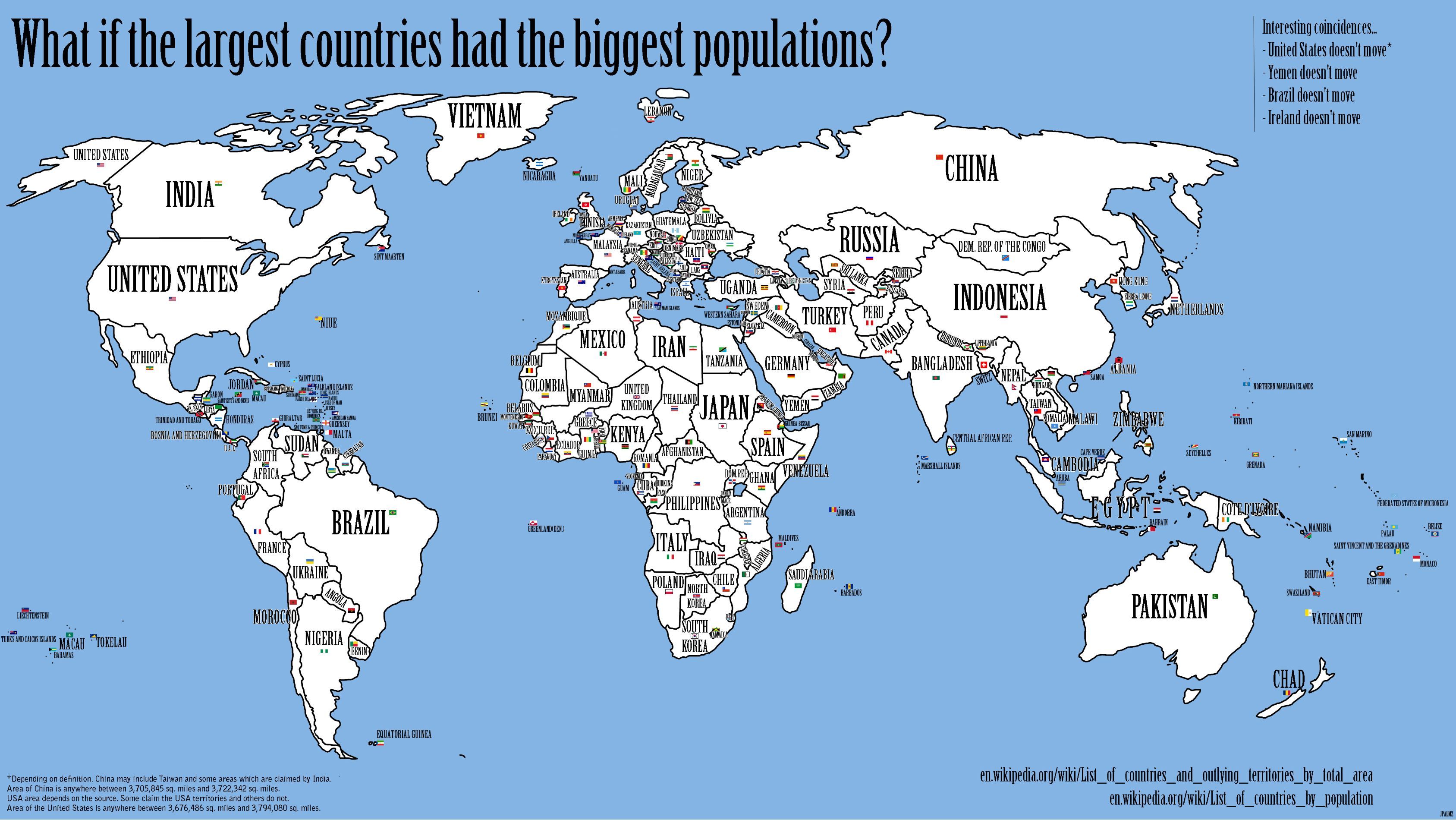
Check out this interesting map from good.is:

See the original here.
The top five in population as it stands today: China turns into Russia, India takes over Canada (which, the authors joke, would make a great arrangement for American companies who outsource technical expertise...), the US stays where it is as the third largest country in both population and land area, Indonesia moves to China, and Brazil stays where it is. Pakistan takes over Australia, and Japan displaces Sudan. Interesting stuff.

When I was born, world population was just under 5 billion. Today, it is almost 7 billion - with some estimates that nearly 99% of that growth takes place in the developing world.

How will we feed everyone? Care for everyone? Where are these people going to go? Already, Indian cities, as well as urban centers in Bangladesh, Pakistan, southeast Asia, sub-Saharan Africa, and Brazil are overcrowded. Around 50% (depends on which estimate you use) of India's population lives below the international poverty line - $1.25 USD a day (even in India, with a relatively low cost of living, that's a mere 55 rupees or less).

Mumbai is a good reminder of what 1.1 billion people really looks like. July 2008.
And bigger questions: how can we foster a world with more people and more perspective? How can longer lives mean more meaningful lives? Can we balance urban development with sustainable outcomes?

Monday, February 7, 2011

things worth dying for are also worth living for

Was catching up with a friend who just returned from several months in Dubai over coffee Sunday (on what's become a rare weekend in Atlanta, as of late), and we got to talking about the happenings in the Middle East. Protests are raging in Egypt, led by a youth movement in a country looking to oust its longstanding President from power.

A protester praying in the street (photo courtesy of... )
It strikes me as strange to think that these protests in Egypt are being led by people my age. Just like those in this country during Vietnam. And those in China during Tiananmen. To think that people would believe so strongly in their cause, at 22, 23, 24. Younger, even. To risk their lives to make a statement. To risk their lives for a reward so sweet as freedom.

These are not trivial sacrifices. The questions are only hypothetical to those of us who are sitting today on this side of our reality.

And so Amira and I asked ourselves, if that was me, if I was there, would I be out in the streets? Would I be protesting? It's easy to sit on this side of the world and say that yes, of course, I would defend my freedoms and stand up for what I believe in, but it's not hard to imagine a world in which people aren't empowered enough to question what they have and don't have. To grow up in a world that allows you to speak your mind. That doesn't block Twitter and censor Wikipedia. In which you don't fear for your life when you choose your friends.

I'd like to think that if I was in that situation I would find something so worth living for that I would die to preserve it.

I can only hope for that kind of courage.

Friday, December 3, 2010

the difference between health and public health

For the second time in two months (and despite getting a flu shot), I'm sick. This is strange for two reasons; the first being that I grew up in a developing country and have an immune system bolstered by 1+ billion people living in an area smaller than half the United States; the second, because I'm a relatively healthy individual who exercises regularly, doesn't (didn't used to) get sick often, and maintains a fairly healthy diet (sleep schedule notwithstanding).
(photo courtesy of... )
If I had to guess, I picked something up at work. Because workplaces, like elementary schools, are incubators for illnesses. It's all fine and well to be a healthy individual with a strong immune system, but throw that healthy individual into a building for 9+ hours a day with others of varying immune capabilities, and it makes no difference how healthy they were to begin with. Essentially, I need my coworkers to stay healthy if I plan on staying healthy, and I derive a very real benefit (in economic terms, an externality) from my team not being sick.

That's the difference between health, and public health. Healthcare, like education, provides benefits not only to the individual that purchases the good, but also externalities to others in society such as increased productivity, lowered disease transmission, and reduced microbial resistance to medication.

Here's the real kicker (and especially in the context of healthcare reform): if all of society derives these benefits from me not being sick, who in society deserves to pay for my health? We've managed to answer that question in education - society pays to educate its children because society benefits from an educated population. Should society be paying for healthcare when that society derives benefit from a healthy population?

And let's take it one step further. In the developing world, individuals cannot afford to pay for the most basic of health services. In these places, though, because of the prevalence of infectious disease, keeping individuals healthy delivers huge impact to others in the population. Globally, preventing an outbreak of infectious disease in Niger means a smaller chance of a compromised population in Atlanta.

So, today's good question: who should pay to keep people healthy?

Thursday, November 18, 2010

a few statistics in global health

Last Friday Massachusetts General Hospital's Center for Global Health had its first annual symposium. It was an incredible turnout - at least 300 or so were in attendance. Lots of good thoughts as I try and wrap up my research paper, but one in particular:

(photo courtesy of MedShare - if you live in Atlanta and don't know about MedShare, you need to volunteer)
I posed a question to Kris Olson, who is a pediatrician and doctor of internal medicine at Mass Gen, and also the Director of the Global Health Initiative for CIMIT, about public-private partnerships and how we make innovation for the developing world a sustainable venture for the developed world. He didn't have an answer (no one does, and even now, only a few people are trying to figure that out), but he did bring up some interesting statistics and the need for healthcare innovation:
~ 40% of needles used to vaccinate children in developing countries have been used in another child before
95% of medical equipment (what we call "durable medical equipment", or DME) in resource-limited areas is donated equipment
90% of those devices fail in the first five years
Dr. Larson, while acknowledging the need for innovation in the space, made a great point: "A need does not necessarily equal a market." Not sure if we can find a way around that, or create a market, or develop a nontraditional market, but answering that question and monetizing that market goes a long way to improving global health in all regions of the world.

Tuesday, November 2, 2010

happy election day (it's a post about Halo)

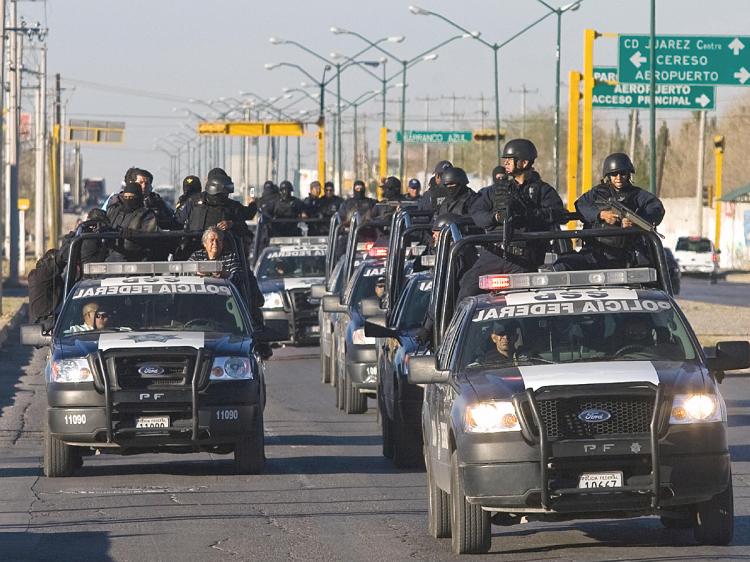
Three months ago, despite the warnings and news stories, I took a trip to our manufacturing facility in Cuidad Juarez. Let me tell you, it was a surreal experience. Mexico is very much a developing country, and it doesn’t look much different from India (with fewer people, more paved roads, and no random animals walking the streets). Border towns in Mexico are regularly patrolled by armed National Police standing in the backs of jeeps. As one of my friends described it, the border security in Mexico is like seeing a live game of Halo.
Zaragoza land bridge in El Paso, Texas/Juarez, Mexico. (feel free to use, with credit)
Over the weekend, two Americans were killed on the land border bridge we crossed to get back into the States – the Zaragoza International Bridge. A third was killed in the city itself.

It’s sad to see a city, and really, a country, be consumed by this kind of violence. We don’t often think of Mexico as a developing country, but it’s not that far off. Juarez is one of a string of maquiladoras that’s been affected by drug violence. I have to wonder how long American companies can continue their operations in Mexico (which offers significantly lower labor costs for labor-intensive manufacturing operations). Many have already left. For the 1.3 million Mexicans that are employed by these maquila factories, a plant closure has a devastating effect on their well-being and empowerment.

A lack of empowerment, and still, voter turnout remains lower in the United States than in Mexico.
The American flag, as seen from the Zaragoza bridge.
It’s an election day to count our blessings.