Showing posts with label design. Show all posts

Sunday, July 3, 2011

less designing products and more designing outcomes

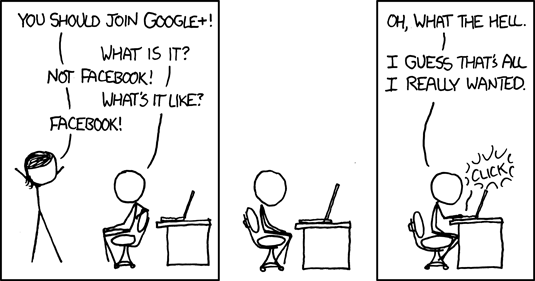
Thanks to Shalini, I started playing with Google+ this weekend. It's definitely interesting. I set up my Circles, checked out some Streams, tried to put in some Sparks (still haven't tried Hangouts - if you're on Plus and want to check it out with me, let me know!). My first thought mirrored the xkcd cartoon, "It's not facebook... but it's just like facebook!"

Rocky Agrawal wrote a great post about Circles yesterday. In particular:
The biggest unsolved problem in social networking remains unsolved with Google+: separating signal from noise. Twitter, it seems, doesn’t even want to try. The timeline is as dumb as it has been since the beginning, a reverse chron firehose of information. Facebook’s feed has improved over the years, but a friend in New Jersey trying to get rid of a bookshelf is just not relevant. 
The lack of quality tools for generating signal out of these feeds is inhibiting the creation of content. People are multidimensional and manual segmentation at the person level isn’t enough. I create content about a lot of things, including social networking, mobile, daily deals, my travel, my reading and more. But as I was reading Onward, I shared less than I would have because I didn’t want to flood people’s streams. If I annoy people, they have a blunt tool to fix it: unsubscribe entirely. So I mitigate my posting.
I'm a very selective content consumer, and an even more selective content creator. I blog, but I won't tweet. I'll post location on Instagram, but not on Facebook. When it comes to organizing my Reader feed or picking people to follow on Buzz or Tumblr, I'm merciless. And as a creator, my biggest concern is not about privacy (although I make it seem like it is). It's about irrelevance.

At the end of the day we don't need more creation and consumption tools. Everyone has their favorites - Facebook, Twitter, LinkedIn, Blogger, Wordpress, Digg, Disqus, Tumblr, Buzz, Flickr, and a thousand others that pop up every day. Right now, all it's doing is giving us more sites to check to get the content that's relevant to us. What's important is how we create value out of these things to generate a stream of content that's meaningful to us. And I'm hoping that as Google+ grows, it addresses the "signal-to-noise" problem that's overwhelming our lives.
The future for content sharing is bright, but the path to get there is still nebulous. Kind of like DTW.
A few months ago I had a great conversation with one of our national sales directors about creating products in healthcare. Healthcare is a great example of a market in which companies have focused on creating and selling products to solve problems. But what's valuable in healthcare is not products - it's outcomes. A subtle nuance, but important. Technology on its own is useless, unless it can drive the outcome - better health, less disease, higher quality of life - that we desire. The tool has to reflect the task.

Google has created a tool to drive its market share in social. It's created a product. But what social needs right now is not products. It's outcomes.

Consumption and creation are huge topics of interest for me. In fact, it was a conversation over seafood in Midtown about how we create and consume that led to this blog. At that time, it was Google Buzz that was new and exciting in social. Now, as I near my 100th post (we're up to 98, for those keeping score) more than a year later, I'm excited to see what Google+ does to the creation and consumption landscape.

Sunday, June 26, 2011

design lessons i learned from the sunscreen song

Lately I've been doing a lot of research about designing clinical interactions. Specifically, in how clinicians can interact with patients to boost healthcare outcomes. It strikes me how similar it all is to happiness research (The Happiness Project was this week's travel book). Designing smart interactions is like designing a happy life:

1. We're happier when we have meaningful relationships in our lives. A doctor-patient relationship in which both parties contribute to the conversation leads to better health outcomes and more patient satisfaction.

Also, did you know that the best predictor of loneliness is the number of female friends you have? Male friends don't make any difference in the loneliness statistics; it's because women are easier to open up to. This might make a great case for why people prefer female doctors.

I also find this sort of worrisome, because I have few female friends.

2. Patients are more likely to be compliant when there is a clear link between action and result. Feedback is a core tenet of interaction design. It's frustrating to receive instructions from a doctor, follow them meticulously, and not see the intended result. Since health is individual and outcomes are not guarantees, we should design devices to facilitate this kind of feedback as best we can. And related...

3. We shouldn't compare our outcomes to those of others. You can replicate treatments, but you can't guarantee outcomes from patient to patient. We're all different, and it takes different things to make each of us healthy. We've all  heard the crazy stories of the man who lived to be 90 smoking a pack a day, and the perfectly healthy marathoner getting metastasizing cancer. Our science is unique; that's what makes us works of art. Similarly, keeping up with the Joneses doesn't make you happier, because the things that make you happy are different.

4. Experiences make us happier than things. Visiting someone in the hospital is much more meaningful than sending flowers.

A great line in the book is "there is no love; there are only proofs of love." This isn't unlike Khalil Gibran's line in The Prophet, "Work is love made visible." Or Covey's idea that love is a verb, not a feeling. Proactive people treat love as an action. But I digress.

5. People who are grateful for what they have and appreciate their lives the way they are have shorter recovery periods and a higher quality of life. So much so that the American Heart Association has counseling programs for stroke sufferers on positive thinking.

Basically, these are all things I learned from the Sunscreen Song (it's here if you haven't heard it). It's easy to overcomplicate clinical design and positive interactions with bells, and whistles, and features. But there are no secrets to happy, and no secrets to healthy, either.

Get to know your parents; you never know when they'll be gone for good. Be nice to your siblings - they're your best link to your past, and the people most likely to stick with you in the future.


Being nice to my brother on Rakhi, many moons ago.
Understand that friends come and go, but with a precious few, you should hold on. Work hard to bridge the gaps in geography and lifestyle, because the older you get, the more you need the people you knew when you were young.


I'm thankful for the kind of friends that bridge gaps in geography and fly into town just to have dinner (thanks, friend!).
Read the directions, even if you don't follow them.

Don't waste your time on jealousy. Sometimes you're ahead; sometimes you're behind. The race is long, and in the end, it's only with yourself.

Maybe you'll marry; maybe you won't. Maybe you'll have children; maybe you won't. Maybe you'll divorce at 40; maybe you'll dance the funky chicken at your 75th wedding anniversary. Whatever you do, don't congratulate yourself too much, and don't berate yourself. Your choices are half chance. So are everybody else's.

Dance, even if you have nowhere to do it but in your own living room.


Enjoy your body; use it every way you can. Don't be afraid of it, or what other people think of it - it is the greatest instrument you will ever own.

Learning something new at Circus Fitness class.
Writing closing sentences has never been a strong suite of mine. It just feels awkward. But I love the ending to the song, which circles back to the research ("but trust me on the sunscreen"). So I'll circle back to the research:
The findings here are tentative and in need of replication. Until then, including empathy in the clinical encounter has little potential for harm and has positive influences that extend beyond the medical consultation. A “connection” also enhances continuity and builds a foundation for relationship-centered primary care within the patient’s medical home.

Sunday, June 19, 2011

commitment, to the problem you want to solve & the life you want to lead

Lunch on Friday in the Financial District. We were sitting in a gorgeous courtyard, full of marble and light and San Francisco sun. I asked Charlie if he ever gets sidelined by the perception from inside a company that consultants come in uninformed about and uninvested in a company's goals and culture, suggest swooping changes and then leave the actual implementation - the hard part - to someone else.

Sure, he said. But that's what happens only when the tasks haven't been well-developed. When a company hires a consultant without knowing what problem they're trying to solve.

This isn't so different from product development. I get frustrated with how often requirements change. Of course, time changes things. Patients change. Procedures change. Technology changes. But what can't change is our commitment to the problem that we were originally trying to solve. That's the easiest way to kill a good product idea before it hits the market.

You can't design to a moving target.

Don't get me wrong. You can design to accommodate change. You can design with a vision of how that design can change. What can replace it. Apple's the classic example of companies that develop products with multigenerational product strategies. But the point is, commit to something. A set of requirements that may not last forever, but that last for right now and give you something to work towards.

Commitment is a whole separate topic. It takes courage. We're so afraid of it. We're afraid of what might happen if we commit to one thing and miss out on ten others. This is true in product development. This is true in life.
Thomas living his ideal life in Napa Valley.
I was reading Unclutterer yesterday when I came across this post. Erin's post is like Covey's second habit: begin with the end in mind. I think the hardest part of being young is realizing that it's ok to change your mind as you get more information. That the ideal life right now doesn't have to be the ideal life forever, that your life has its own multigenerational design strategy. What shouldn't change is your commitment to live according to the things that you value

Tuesday, June 7, 2011

five years ago i worked in the emergency room

One of my new goals is to learn everything about core body temperature in the ICU. Why it’s taken, how it’s measured, when it’s used. What information it gives a clinician and how they can use that information to drive clinical interventions. It goes without saying that I’ll be spending some pretty significant time in the hospital over the next several months.

Five years ago this June, I worked in a hospital. Grady Hospital, specifically, in the trauma center. Grady is one of those classic inner-city hospitals you hear about. It’s the largest trauma center in the Southeast, and the only Level I trauma facility within 100 miles of Atlanta. My first day, we intubated a woman shot in the mouth during a work scuffle (she lived). My last day, we watched a chief resident attempt a full thoracotomy on the way to the elevator for a man who had been shot in the chest with an AK-47 (he died).

I was technically a Research Associate. We were supposed to be running four studies for PIs at Emory – interviewing patients, coordinating with pharmacy, observing procedures, the like. Honestly, I don’t remember doing much other than talking to the homeless people about their smoking habits (one of the studies) and waiting for two hours by the bedside of a man who had a seizure while driving so we could measure the extent of his head injury (another study).

What I do remember learning that summer was how little of being a doctor is treating a patient’s condition. Instead, and especially in a place like Grady, it’s about demographics, socioeconomics, and psychology. And paperwork, too.

You do more for a patient by helping them find a job with a decent wage than you do by prescribing anti-depressants. Or by reducing sodium intake instead of prescribing lasix in patients with CHF. Or just by sitting at the bedside with an elderly homeless woman who has thrown herself off a bus to get a place to stay and a person to talk to.

I always meant to be a serious blogger about device design. I think I write about design like James Altucher writes about hedge fund trading (he doesn’t). That summer at Grady was for my medical school dreams what this blog is about my life as a designer.

Five years ago, the day before my birthday, I was at the hospital late. I was scheduled to leave at 8, but at 7:15, we got our first LifeFlight call. A peds case, but no details. In the hospital, “peds” case can be anything from a few months to 18 years old. Half an hour later I rode up to the roof with another research student and a PA, a stretcher and an excited silence between us.

The next day, my 20th birthday.
I don’t remember what actually happened. A helicopter landed. A boy, bigger than I was, was pulled off the board and onto the stretcher. We ran back to hold the elevators for the trauma team on call. I remember pointing out that he might be a candidate subject for a design research study, but quickly dismissing the thought as we took a separate elevator back to the trauma bay.

The details came slowly, from quiet conversations at the nurses’ station and the residents’ orders to the pharmacy. He was 15, spending the holiday weekend at the lake with family. He played football at the local high school. He was a good student.

He had attempted suicide.

His parents came in, having driven from the lake, about 45 minutes later. I vaguely remember the attending dismissing the first and second year residents minutes before they walked in. It’s hard to understand what to say to a parent whose son has just attempted suicide when it’s your first week on the job at Grady’s ER. I remember standing in the corner of Trauma 2, peeking into the next room, thinking that he was just three years younger than I was, and yet we were so far apart.

It's a patient privacy violation to take pictures of patients in hospitals, but this seemed fitting.
I think about that night a lot. About the look on his parents’ faces when they walked in to that trauma bay. About the promise of a young man’s life – a young man who hadn’t yet learned to drive, or been to the prom, or filled out a college application. About the life that lay ahead of me at 15. About all the things that I had yet to do and see and experience.

Sometimes, when I am in the hospital doing design research, I think about how all the technology in the world can’t save you if you don’t nurture the soul inside you. That all the diagnostics in the world can’t tell you everything that’s going on inside the human body. Design becomes practical to me in that moment. Hope becomes visible. We become human.

Monday, May 30, 2011

multidimensional design and a fresh start

I found out this week I'm switching teams.

For those with a background on the medical side of things, I'm leaving the Vascular Interventions team to head over to Critical Care / Renal Function. From a purely clinical perspective, this is a huge opportunity. Bard's big business is in Foley catheters (this link may or may not be SFW... depending on where you work), and more than 10% of its annual revenues as a corporation comes from the critical care Foley business. I'm going to be leading a huge project involving core body temperature and diagnostics, and I'm tremendously excited to get started.

Of course, I'm sad to leave my team behind. If you are one of the people that enjoys my gchat status updates during the week, I regret to inform you that the days of ambiguously hilarious updates about "PWOMs" and "LBigs" are numbered (or at least, will be reduced). Over the past two years, we've become not only subject-matter experts in venous infusion, but also good friends in the process.

Last week, I sat down with my new boss to discuss human-centered design. It was interesting, in that the conversation was happening between two engineers who see their craft as a balance of logical facts and human misgivings. We are consummate systems thinkers, trying to find where people fit into process.

Not to knock engineers (after all, I am one), but part of our problem in product design is that we try to systemize everything. We want an orderly and repeatable process to come up with orderly and repeatable innovations. Life is messy. It doesn't flow gracefully in neat, logical form. Instead, it flits its way from idea to idea, lumping together things that have no business being put together.

I'm trying to find my place in between designers and engineers. I think, then, it's important to build our lives richly, to cultivate experiences that can show us different dimensions of the problems we're trying to solve. It's the officially-unofficial first weekend of summer, and as I get ready for a fresh start on Tuesday morning learning about sepsis and kidney function and multiple-organ failure in the ICU, I'm trying to commit myself to an exploration of multi-dimensional design as well.

1. Two-dimensional design. I'm a lousy artist, so I take photographs instead. Here's a photo that sums up the weekend in Atlanta:

It's only May...
2. Three-dimensional design. I've decided to build a desk. Well, sort of. I wanted to build a desk. Then I realized that there are desks out there that are almost what I want. So I decided to find a desk to repurpose and refinish. But that's proving to be more difficult than I thought.

Four furniture stores and two hardware stores later, this is the best imitation of butcherblock I could find :-/.
3. Four-dimensional design. A new dance class that reminds me of why I started dancing in the first place. This weekend we're finishing up Ciara's Gimmie Dat, one of my favorite songs-of-the-moment (the video's choreography isn't as good as Vera's). I'm always impressed with the ability of good choreography to translate energy, emotion, and passion from individual movement and isolations to an entire crowd of people.

Since I didn't get to wear Ciara's awesome A-town hat in our video, I'll post this picture instead.
Our brains aren't wired to work in logical systems. Design is just as disorderly as life. Composing photos, creating a desk, and a choreographing a hip-hop class can teach us something about uniting human needs with systems capabilities.

Sunday, May 22, 2011

the little things on my mind

It's Sunday night and I'm spent.

It's the kind of weekend that's spent working on the little things. So often we wait for the big things that will define us - a degree, a particular job title, a promotion or a product launch. But life isn't lived in the big things.

I got an email earlier this evening from a friend of mine (and I hope you don't mind that I quoted this):
"[...] i'm glad that you post. particularly with the material that you do because if you tried to share this information on an individual basis, i might never have heard you "talk" about all the things and topics that you blog about. in fact, your blog actually helped me refine my "public health" eye to include a design element. plus your references to various books and articles inspired me to read them too and find ways for them to relate to my work and passions. [...] 
so basically, thank you for blogging. i know it's hard but i'm glad that you do.
It's a small thing, and I get a fair amount of emails about the blog, but it made a difference. In a world of big things, a small thing like a thank you can change everything.

Lehrer writes,
"This is life as it's lived - our epiphanies inseparable from our chores, our poetry intermingled with the prose of ordinary existence."
If we live intentionally, we design our lives to take care of the poetry. But in doing so, we sometimes forget to appreciate the beauty of the prose.

So tonight, some snapshots of life's ordinary moments as they're lived - small celebrations among the chores.

I laugh at this at least once a day. The line about dry cereal? So true.
A small tradition that's still going strong. Better Than Ezra at Center Stage.
Sawra making friends on our weekly pilgrimage to the Piedmont Dog Park.
A little part that's a big part of my life right now.
A little space in a cab with seven others.

The simple joy of using fat Sharpies vs. skinny Sharpies. You know you know what I'm talking about.
Sometimes the little things are actually really big things - wearing the insanely huge ACC championship ring, looking far less cool than the owner.
I was babysitting the little cousins on Friday night, and we happened to be watching Cartoon Network. I wondered aloud why in the world they show human tetris on Cartoon Network, of all channels, when my 8-year-old cousin piped in, "People like to watch other people get smushed by foam walls and pushed into pools of water!"

Yes, sometimes, it's the little things in life.

Friday, May 20, 2011

caption contest: improper microwave use

In this week's episode of poorly-worded design, we have the cup I tried to make oatmeal in this morning:


I'm honestly not sure what that's supposed to mean. So - tell me friends. What constitutes "proper" and "improper" microwave usage?

Best caption wins a prize.

Friday, April 22, 2011

designing cradle-to-cradle

In honor of Earth Day, a question: for any of you in [product] design, who generate physical things as a result of your work, have you ever designed anything to be cradle-to-cradle?
Chicks dig recyclers (true story). World of Coca-Cola, Atlanta, Georgia.
As in, something that can be completely repurposed and completely diverted from the waste stream?

It's a difficult proposition in medical devices, because of biohazards and body fluids, but I'd be curious to see some good examples of how, in this age of smarter consumption, designers are coming up with smarter creations as well.

On another note, I've posted three times in two days! That's got to be some sort of record or something. I'll take a cookie for that.

Thursday, April 21, 2011

first shots off the mold, and all the emotion that goes with it

It's been a day.

A lot of you have heard the stories I’ve told of being responsible for a major product launch (less than two months now, and counting, if we ever get our QE back). Most of you that know me personally also know that I'm pretty even-keeled. Our head of BD told me I'm too "smiley." My boss, in fact, told me last week that I don't get mad enough.

Today, I was all over the emotional spectrum. It was interesting to see our team react to my excitement about first pieces off the mold, my frustration about losing my Quality Engineer to another project for another week, and my stubbornness in taking a stand about the scientific analysis we have to perform to release a new product.
An artsy (and purposely ambiguous) photo of first shots.
Anyone that works in product development will tell you that they don’t learn nearly as much from the things that go right than they do from the ones that go wrong. We’ve had plenty, over the past 15 months, go wrong on this project. Today, I let some of that bubble to the surface.

A lot of people are afraid to let their feelings be known in the workplace. I think we're afraid of confrontation because we mistake confrontation for conflict. Even in our personal lives, we don't necessarily want to show our excitement in case we're disappointed later.

But sometimes, we need to embrace how we're feeling. I've spent three weeks being incredibly mad about having a team member pulled at a critical point in the project. I was exhilarated to see a design that we have been refining and iterating for months, finally make its way into a part. And I was exhausted to see that despite all the progress we've made, we've still got a long way to go. The trick is being able to channel those complex emotions into momentum for action. To use those emotions as constructive motivators, as lessons learned. The last 10% to get a product out the door is the toughest 90% of the work. I'll be down in Mexico in two weeks building parts for the first time.

But today, some vindication. First shots off the mold look stellar, and more importantly, they WORK. It's rewarding to come full-circle and see a functional part nearly a year and a half after first starting down this road. I'm sure it will be even more rewarding to see a design that I contributed to and filed IP for, finally being used on a patient in a few short months. Talk about hope made visible, in the form of polycarbonate injection-molded parts.

Monday, April 11, 2011

the new rules for design & science

A bit ago, Tim Brown from IDEO wrote a post called "Design Renews its Relationship With Science."
My own view is that the latter half of the twentieth century saw a steady decline in designs interest toward science and technology as engineering inserted itself between the two. This is not a criticism of engineers who, in places like silicon valley, performed wonders with the new technologies of micro-processors, storage, networking and software to create the products and services we rely on today. The same is true in other fields such as aeronautics and bio-medicine. No, my criticism is of the designers and scientists who have relied on engineers to provide the translation between their two fields. My concern is that in this translation much is lost that could benefit scientists, designers and the end user.
I think "design" has gotten clique-ish. We hear the term designer and we think artsy, creative types who hang out in art museums and doodle in their margins. We've mistaken creativity for quirky stereotypes.

I saw a friend of mine last week at the Cherokee Club who is a designer by training, and he remarked that he didn't know I "design." And it's true: I have no background in graphic design, I've never taken a course on fabrication, I like my margins neat and doodle-free, and although I like museums of all sorts, I have no appreciable ability in sketching or drawing (well, I can draw a mean stick figure). I am more science than I am art.
Working on one of the first designs I created - on the apex of a pig heart.
... and then eating said pig heart after the experiment (I kid, I kid).
I try not to feel bad about calling myself a designer. But no matter what you call it - design, ethnography, imagineering - design is about how people interact with things. How we can create products and systems that interact with people the way people need to be interacted with. And that's what I'm interested in.

The lines are blurring between design, science, and engineering. Here are some new rules about navigating the gap.

1. Function first, form to follow. The world is full of designs that beautiful, but not useful. Don't just sell products. Solve problems. In a world full of "stuff", it's irresponsible to create something beautiful that isn't also useful...

2. Form does not have to be sacrificed in a functional device. ... and it's ignorant to create a highly useful device that people aren't attracted to. As our lives get more complex and our experiences richer, we tend to seek out services, systems, and products that engage us and satisfy us on many levels. We are trained to seek beauty in our lives.

3. Good design doesn't cost more than bad design. Good design just takes perspective and presence to observe how people behave in the world, and to listen to their experiences with the things that they use.

4. Listening is underrated. As a design tool, as an ethnographic method, as an engineering talent. The best way to understand what it is that people need is by asking the question and then shutting up long enough to actually hear the answer.

5. Designing a product is just as important as designing a procedure and a system of use. What good is a medical device if you can't get it to the bedside? If you don't have an appropriate channel strategy, distribution network, or carrier, no matter how clever the science or useful the product.

Tuesday, March 29, 2011

what's in your bag?

I find the "What's In Your Bag?" phenomenon a weird voyeuristic sociology experiment. It's interesting to see what people find so important that they carry it around day after day.

As I've gotten older, I've learned to be more mindful about what I carry. To pay more attention to the baggage I bear and how it changes the way I approach the world. I try to make sure that the contents of my bag reflect the kind of life that I am trying to lead - no more, and no less.

One of the reasons that I adore my iPhone is because when I first got it, it replaced my iPod, camera, GPS, calculator, and Blackberry, all of which would be crushed in the bottom of my bag with binders and pens and the old TI-83 that any good engineering student carries. It's a good example of how clever design can replace a hundred other things that we are liberated from lugging around with us.

So, here's my "What's In Your Bag?" post - feel free to psychoanalyze.

What's in my bag.
From top left, moving in horizontal rows: Macbook Air + Incipio case, pink Play-Doh, water bottle, gold Club Monaco pouch to hold various cords & cables [laptop charger, camera transfer cable, camera charger, headphones, etc.], 4 x 4 gridded notepad and LePen pen, Kate Spade sunglasses + case, hairbrush, black eyeliner, chapstick, Neutrogena compact, wallet [4 credit / debit cards, $21.17 in cash, Starbucks card, High Museum membership card, health insurance cards, ID], dog bag, business card case, keys, camera + case, iPhone.

Now that you know what's in mine, what's in your bag?

Tuesday, March 22, 2011

it's amazing what you hear when you take the time to listen

I used to think, when I was young, that to be a good doctor, you have to be a good listener (from the time I was five, I wanted to be a doctor). Then, when I got my first job, I learned that to be a good gymnastics coach, you have to be a good listener. When I came to college, I learned that to be a good public servant, you have to be a good listener. And now, when I design products, I absolutely know that to be a good designer you have to be a really good listener.
The moral life, the life that transforms lives, begins in the ear, in the act of listening.
                                - Rabbi Jonathan Sacks, To Heal A Fractured World
If you want to design the kinds of things that remove shackles, that empower people, that transform people's lives, you have to start in the ear - with the act of listening.

We pay lip service to listening. We all know how important it is, but we don't always do it. We get too busy; we want to make our points; we want to win our arguments. Listening solves problems. It creates white space. It fosters creativity.


Here's a video I took in Decatur Square last weekend (in 75-degree March weather). It's amazing what you'll hear when you just take the time - no iPod, no text messages, no notepads, no agenda - to listen.

Monday, March 7, 2011

the conflict of hurting to heal

Elli was in town this weekend (he hates it when I call him that, but some habits die hard). I've been meaning to share his post for quite some time, but haven't found the right words to introduce it. I remember it often when I'm in the hospital. Sometimes I get the thrill of seeing my designs and devices on patients, but I'm often immediately brought back down by the realization that to see my success is to see their suffering. Elli's words are humanizing - a reminder of the "conflict of hurting to heal."

Having a thug contest at Cypress Street. The Lou is no match for A-town.
Current location:Third Floor Carrels
Current mood: thankful
Current music:Pandora
Sport

In the past two days, I've had a lecture/case study and read about ALL. This reminded me of my first patient, our anatomy cadaver. Although we couldn't help him in any way, I certainly hope that all he taught us will help countless patients during my career. I wrote this about him for the Cadaver Memorial Service at the end of our first year.
For Sport
We have been told that our patients will be our greatest teachers, and we will always remember him as our first patient and surely one of our greatest teachers.
The bulletin board called him, “African American male, age 20, acute lymphoblastic leukemia.” We found that we wanted to know him better than that. We started by looking at his face. Some of us needed to see his face the first week, so we pulled back the cloth and stood in silence, taking in his features. Others just saw the contours through a freshly wetted cloth at the end of the day. Either way, he became more than a body to us, he was a person, and as we pulled him apart piece by piece we felt the conflict of hurting to heal, of having to harm and invade our patients to try to make them better. With him the conflict was even more poignant as we harmed a man we could never heal. On the day we began to dissect his face, one of our group members cried. The rest, though stoic, understood why she was crying. We called him Sport. It took some time for this nickname to catch on. We first spoke of him in hushed tones, with no name at all. We came to know him too well for him to not have a name, so we gave him one. Eventually, we found that the nickname Sport fit him much better than anything else we could have thought to call him, short of his real name. I hope he would not consider it irreverent that we called him by this nickname. It was not given out of callousness or even convenience, but it was more like the way you sometimes find that you and your friends no longer call each other by name, but rather by nicknames that just fit after spending long quality hours together. Sport became a friend after long hours together, and he deserved a friend’s name.
Had he been a real patient in the hospital, there were many times we would have called him a “Difficult Patient,” or even “Noncompliant.” Our note in his chart might have read, “Patient is uncooperative with the week’s prescribed regimen of completing pages 53-67 in Grant’s Dissector.” We struggled with his 20-year old connective tissue and with the fat and lymph tissue that coated and invaded his body during the course of his disease. We left last almost every day and stayed late on other days, and we still never seemed to finish a dissection. Even TAs and professors seemed to occasionally leave our table in frustration in search of an easier dissection with clearer structures. And yet, we toiled on. Our struggle was rewarded when we discovered beautiful structures not yet broken down by long years of life. We became more confident in our dissection technique. We felt that we would be prepared if we ever operated on a young body. Through our “noncompliant” patient, we learned to work hard for our patients, and we learned that the extra time and effort will pay off in the end.
We all wondered what led a 20 year old man to give his body to be clumsily dissected by untrained, awkward hands. We talked about it often as we went about the business of anatomy lab. For other tables, the conversation may have been similar as they pondered whether or not they would give their body after death. Still, I imagine the thrust of the conversation was significantly different…as other tables wondered whether they would be willing to give their bodies after a long life like so many of the cadavers, we wondered whether we would be willing to give our bodies now. As one of our group exclaimed on the first day, “he could have been on Facebook.” That really hit home for me. I hope we would have been facebook friends, but instead of checking his status updates, we were exploring his innermost parts. We did not know him during his all-too-brief life or during the illness that unfairly shortened his days. I wish we could have known why he gave his body…what his hopes were for the future doctors who were with his body during its last few months as a body. We speculated that maybe he wanted to give something back to the medical field that we hoped had treated him skillfully and compassionately. Maybe he was just young and rebellious and wanted something extraordinary done with his remains. Maybe after such a short life, this was a chance for him to have a legacy carried on in time by the four of us who so benefited from his gift. We will probably never know who he was, what he was like, or why he gave his body. Our great hope, Sport, is that we will become the kinds of doctors that will make whatever reason you had completely worth it.
Thanks friend, and godspeed.

Monday, February 14, 2011

buying stuff with the irrational brain

I just bought a new laptop. This is no small feat, because I've been thinking about the purchase for at least a year now (I bought a new desktop in June instead). There's been a lot of internal (and external) debate about features and benefits and functionality. About Arrandale processors and how many gigs of RAM one needs. About portability.

Sawra approves of the new laptop (feel free to use with credit)
I just finished reading Jonah Lehrer's second book, How We Decide. In it, Lehrer makes an interesting point about purchasing decisions - that when we try and give our prefrontal cortices - our rational centers - too many variables to consider, our brains get overwhelmed and they give up. Our emotional brains have strong reactions to things, and when we're asked to make complicated decisions (like, buying laptops), we really should listen to what our amygdalas are telling us.

Tim Brown once said, "As a designer I ply my craft in the turbulent waters between the complex things we create and the human beings they are intended to serve." Our rational brains are really good at analyzing the complexity of objects that we have, but they are poor predictors of how usable they're going to be in our lives. That's a good challenge for designers to keep in mind - to help people bridge the gap between functionality and usability. Function is rational. Usability is emotional.

A month ago, during Snowpocalypse-turned-Icepocalypse in Atlanta, I impulse-bought the laptop that I should have bought nine months ago. In the month that I've had it, it's barely left my side - from Breckenridge to El Paso to Baltimore and back.

And you know what? It's the best laptop I've ever owned.

Sunday, December 26, 2010

designing experiences

When I think about my hometown, there are a few defining experiences that come to mind. Running through Mountain Park on Thursday evenings in the fall, surrounded by the sights and smells of football in the South. Summer nights at Bruster's that seem to stretch on for hours, laughing at jokes that are still funny after retelling them for years. IHOP breakfasts and Ponko lunches. Traffic on Cole Road at 6:45 every January morning.
Sawra enjoying her iced green tea. (feel free to use with credit)
And of course, our Starbucks. We have a beautiful Starbucks that sits out on Lake Lucerne. On clear days, you can watch the ducks playing on the water. At Christmastime, lights shine across the lake, giving it an almost ethereal glow. And on stormy days, the black water will chop at the dock and patio, lending the atmosphere a pensive aura. There isn't a drive through, meaning that everyone that comes by has to stop inside the little shop and say hi. For the past ten years, since I've been able to drive, Starbucks has become a staple of our Lilburn routine. Meeting friends for a cup of coffee, writing a paper for my research project, or having a conversation that changes everything - that Starbucks has played host to a number of memorable moments, in my life and in others.

It's amazing how that atmosphere, that design changes things. Because it's a small shop, because there are only a few well-worn couches and small tables, because there is no drive through, the ambiance inside that Starbucks is far less commercial than any chain coffee shop I've ever been into. The manager once told me that that particular location has one of the highest percentages of "regulars" of any Starbucks in the nation. As for me, three or so mornings a week, I'll stop in for my green tea and vanilla bean scones (you have no idea how good these things are). Patty and Shanna know what my order will be before I get to the counter. I'll say hi to Joe and Greg, and wave at the police officer who has undoubtedly stopped in for a drink before getting on with their shift. The experience of Starbucks has come to mean more than just scones and tea - it's come to mean that I will always walk out in the mornings with a smile.

Today, that Starbucks is closing. The landlord has decided not to renew the lease, and despite being very busy and very profitable, tomorrow, after a beautiful white Christmas in Atlanta, the doors won't open.

The best experiences are the ones that linger for days, weeks after they're over. It's one thing to be able to create that kind of experience with a one-time event - a special outing, a big celebration. It's another to design an environment that consistently leaves people walking out with a smile. I will miss my Starbucks, for sure. Although I may find a replacement for my morning tea and scones, I will not find a replacement for the experience that changed my mornings.

Sunday, December 12, 2010

what is your relationship with money?

Not sure if any of you are Bank of America customers, but I dropped by IDEO Palo Alto on Friday afternoon to have a conversation with Altay Sendil about the emotional and human aspects of the goods and services we use.
(photo courtesy of... )
The Keep The Change program (I'm not a BofA client) is one of my favorite examples of good design strategy. When BofA was looking at creating an easy savings account, the questions started (predictably) about how we use savings accounts - about interest rates, linked accounts, online tracking, and other functionality that we classify as "account features". But the interesting question is not how we save, but why we save. What is our savings paradigm? Fundamentally, how do we interact with money? What are our deep-seated attitudes, our internal scripting about spending and savings?

Understanding the why was important to making the how work. The Keep The Change program is very well-received in the consumer banking arena.

Microfinance in developing countries caters to similar attitudes. Repayment rates for microlending in Bangladesh are unbelievably high - not because people are more capable than in other countries to repay the loans, but because the lending structure - the women-centric, group-accountability, installment-structured system of lending - works for the villagers who take the money. The process fits with their relationship to money and the way they view capital and investments.

I have a Way2Save account with Wachovia (Wells). As I build my own financial paradigms and explore my attitudes toward wealth and savings, it's been interesting to take a deeper look at how I interact with money, and to talk to others (including my parents) about how they deal with their own finances. About saving and spending. About the things that I value and what I'm willing to pay for them. About creation and consumption.

So how do you interact with your savings? When you were growing up, what did you learn about saving and spending? Ultimately, what is your relationship with money?

Wednesday, November 10, 2010

designing around the generation gap, in goods and experiences

Last night, Rafael and I were marveling again at how little human interaction a business trip actually takes as we picked up our rental car at BWI. Everything was going smoothly - flight landed on time, bags arrived, the Hertz Gold Club had us listed on the billboard, and we were just talking about how an interaction-less culture means a higher bottom line for a company, when we discovered that they had given us a hybrid.
(Nissan Altima hybrid, courtesy of...)
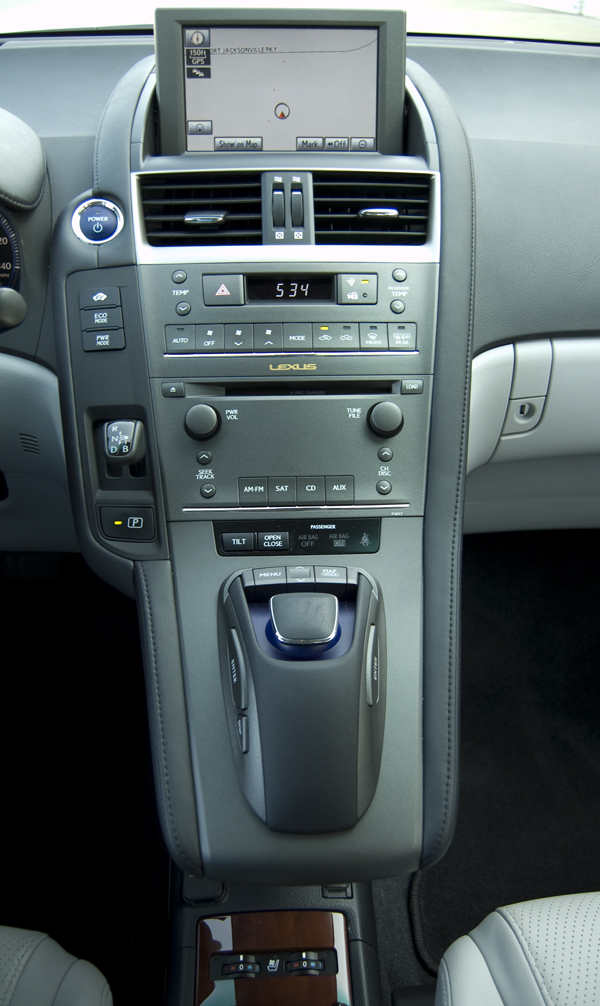
Being the office treehugger, I of course was thrilled. I've driven a hybrid once before (the HS250, and while it's not perfect and there are some peculiar styling details in the center console that I don't adore, it's still a great first stab at a luxury hybrid). Rafael, on the other hand, was not so excited. On normal days, he drives a C280 that was made in Germany and imported into the United States. He loves the feel of the road and the paradigm of driving for him is driven by lots of sounds and textures. It's much harder for someone like that to get used to a car that is silent upon starting up. In fact, it took him three tries of pushing the On button to realize that the car was actually on, and in fact we were in a hybrid vehicle.

While we laughed about it on our drive to dinner (with Rafael nicknaming our Nissan Altima as "the sewing machine"), we started talking about how generational differences make for different user experiences. Like traveling for business without interacting with a single customer service representative, driving a hybrid is an experience tailored for a specific generation. My paradigm of driving has been developed over eight years, and has always involved one primary vehicle. My boss, on the other hand, has been driving for almost 30 years, and those layers of memories and thoughts toward the experience of being on the road shape his product preferences very strongly. Those paradigms are different; the things we value are different.

Back to business travel - I'm part of a generation that has always valued time as its most precious resource. Unlike baby boomers, who chase money after growing up in a relatively less well-off setting as their parents were still handicapped by the economic climate of the 30s when they were starting careers, and unlike Generation Xers, who chase family time after growing up never seeing their parents as they strived to fulfill their American Dream, we grew up overscheduled with ball games and tutoring and soccer practice and flute lessons.

So now, we don't chase money. We want time. We want all of our time to count for something. We recognize that once it's gone, we can't make more. And that says something about why we flock to things like climate change and public health. We have a defined amount of time on earth to tackle these problems.

The culture of business travel is ok for Generation Y, because things that are designed to automate the process also take us less time to accomplish. The culture of business travel is also ok for the Baby Boomers, because they value money. But Generation X traditionally values interaction.

So what does that mean for a user experience designer? How do you design for people who have very different paradigms of how the world should be? The user preferences aren't always the same. In some cases, the end goals aren't even the same. It's not always practical to design different experiences for each of those groups. How do you make sure you've identified with one without alienating the others?

One man's dream car is another man's sewing machine.

Sunday, October 31, 2010

how can we design to inspire self-efficacy?

I went to a talk yesterday by Josh Chuzi for Atlanta Design Week called Healing Environments: How Art & Design Can Improve Health. Although the context of the conversation came from his background in art history, he posed a very interesting question: how can we design to inspire self-efficacy?

The World Health Organization defines health as a state of complete physical, mental and social well-being and not merely the absence of disease or infirmity". Chuzi talked about healing as a multifaceted term as well, highlighting not only physical healing, but psychological, spiritual, social, cultural, and sexual healing as well. The common theme in healing, though, is to build (and I don't love this term) self-efficacy.
(thanks, Wikipedia)

The prevailing attitude in the healthcare environment today is to treat the physical body. According to Maslow's hierarchy of needs, we must address the physical, corporal needs first. I think, though, sometimes in the current state of healthcare in the world today, we take that need out of proportion with the others. As a medical device designer, I see that we certainly think first and foremost (and sometimes solely) about how medically efficacious a device or therapy is. While that has to be our primary concern, it often becomes our only concern.

We lose sight of the human element of healing. The need to feel nurtured, stimulated, and protected - emotional self-efficacy. The need for our family and friends in times of medical emergency - social self-efficacy. So how do we inspire patients and clinicians to strive for that?

And even more importantly, how do we inspire patients and clinicians in the developing world to achieve that goal as well? In places where empowerment is in short supply, how do we create products and processes to drive people to total self-efficaciousness?

Clever design takes these things into account. That's why music videos in India work wonders on rural literacy rates. That's why Paul Farmer's DOT program was such a success in Haiti. And why Greg Mortensen is able to effectively counter the Taliban's madrassas in northern Pakistan and Afghanistan by building schools.

No, clever design can't do this on its own. Empowerment and self-efficaciousness are a partnership of people, product, and process. I suspect that in the next 20 years in this country, we're going to see a dramatic shift in how doctors see patients. As costs continue to rise, we're going to have to. The process by which we pay for healthcare will change. And the products that we use will have to adapt to keep up. Health is about a whole person. While the medical profession is segmenting and specializing further, the processes and products that we use have to be able to synthesize those specialities into a whole person again.

Monday, October 25, 2010

question your assumptions

During my sophomore year of college I took a class in engineering thermodynamics. It was the kind of class that makes young engineers change majors, where the professor told us on the first day that 60% of us would fail the first test (we did). 

About that time in my life, I received a card in the mail from a mentor of mine. I'm a big fan of Quotable Cards (I'm a big fan of good quotes), and this particular card is still sitting on my nightstand.


Part of becoming an engineer is learning to make good assumptions. But part of being a great engineer is learning to question those assumptions.

It's this part that's lost in lots of designers.

In order to start the design process, you have to make assumptions. To solve a complex system, you have to engineer with information you don't have yet. The design process dictates that you generate design inputs - that is, physical specifications, dimensions, materials... what the product will look like - before you can even create a prototype. And professional engineers do a great job of checking to see that their product meets those design inputs. That's design validation.

But what about verification? What about verifying that my product does not what I wanted it to do, but what my doctor wanted it to do? what my patient wanted it to do? That's design verification. And that's where it becomes important to question your assumptions.


In the past two years I've learned a lot about myself as a designer. I've brought three products to market, taken a course in SolidWorks, and spent significant time in the hospital with clinicians and patients. I've been to a manufacturing plant in Mexico and created a new process for adhesive coating in New Hampshire. I've found that in my career what I'm best at is asking questions, and questioning assumptions. I spend my time in the top half of that graph - on asking why we're doing what we're doing, and how a product behaves with a patient.

I think we can all benefit from questioning our assumptions. Making an assumption is answering the question of how to do something. Questioning assumptions is about asking why we're doing it in the first place. It's about being mindful of decisions, of interactions, of relationships. So go ahead and jump into a problem headfirst. Make some assumptions. Move forward. And then come back and ask yourself why. Look at the assumptions you made, and question whether or not they were the correct ones. Give someone else a chance to surprise you. Give yourself a chance to surprise you.

Tuesday, October 19, 2010

surprise & delight, and the story of lexus

Today, I was driving down I-20 on my way home from work, and the 18-wheeler in front of me had a tire explode. This isn't the first time I've had a run-in with rogue tire treads - two months ago, a flying tire tread knocked my side mirror out of its position. In fact, when you have a 35-mile commute each way down a highway known to be a tire graveyard, you know it's only a matter of time before you're the unfortunate victim of a flyaway tire.
(photo courtesy of...)
It's in situations like this that I really appreciate my car. I drive a 2002 Lexus ES 300 - a grandmother's car, although I'm pretty sure that neither of my Indian grandmothers ever had a drivers' license - a hand-me-down from my father that's been through 8 years of everything that Atlanta driving has to offer. The more I drive and the more I design. the more I appreciate the thought that goes into Lexus's design choices. There are few companies that I respect more (Apple being another, for their superb focus on design intent). Lexus stands out for a few different reasons:

1. Lexus doesn't engineer cars. They engineer experiences. There is an R&D director that I work with that talks often about the principle of "surprise & delight" - that is, not just meeting design requirements, but exceeding expectations. Surprise & delight is about understanding your design intent, about taking care of tasks that your user didn't even realize they were trying to accomplish.

So they employ hundreds of human factors engineers to study how people interact with their cars. The company understands very well that what people need out of a car isn't the maximum amount of horsepower or payload. People buy cars for the experience of driving. Lexus doesn't focus on features - sure, they have beautiful interiors, state of the art navigation systems, and a thousand other features. But when that tire tread blew up in my face, what I noticed wasn't the automatic stability control that kicked in - it was that I heard only a muted pop in place of a loud bang. The environment inside my car stayed calm, even when my heart skipped a beat.

2. Consumers are far more mature in the car-buying market than they are in other consumer goods. No one tells me to buy a compact hybrid when what I really need is a pickup truck (but lots of people will tell me that I need a Macbook Pro over a Macbook Air). We understand our needs far better in automobiles than we do other things. And that's why Lexus is so successful - they know they can engineer the experience of driving because it's something that people understand very well.

I know how to check my gauges and change my tires, but even the engineer in me doesn't crave horsepower over simple creature comforts.

3. They anticipate how the driving experience should be - from start to finish. Lexus makes sure that at no point in my driving life, I drive anything other than a Lexus. From the showroom to the test drive to routine maintenance visits in which I get a Lexus courtesy car and free gas, the company always has their best foot forward to make things easy for a customer. Sure, they may lose a little bit of money filling the tank back up for you after you've spent the day cruising around in one of their new models while getting your timing belt replaced, but they more than make up for it in loyalty when you buy your next car.