Showing posts with label globalization. Show all posts

Wednesday, May 4, 2011

back stateside, and safe in el paso

Our latest adventure in Mexico is over.

I have lots of thoughts from the visit on Mexican business culture, on the balance between American prosperity and Mexican labor, and on my experience hand-building parts on the manufacturing floor (and I'm sure I'll get to those... all in good time), but crossing the border and seeing flags flying always reminds me of how thankful I am for the opportunities I have being an American.

The vehicle border crossing at the Zaragoza bridge.
Crossing the border in Juarez is always a strange and sort of surreal experience - and doubly so after the events of this week. A friend of mine wrote an op-ed for the Atlanta Journal this week on what it means to be Muslim-American (an excellent piece, and I highly recommend it!), and today, as we walked across the Zaragoza land bridge, over the Rio Grande and back into the states, I took a minute to read the words on page 14 of my passport:
“Let every nation know, whether it wishes us well or ill, that we shall pay any price, bear any burden, meet any hardship, support any friend, oppose any foe, in order to assure the survival and the success of liberty.”

Monday, May 2, 2011

a crazy end to a very eventful week (month)

http://english.aljazeera.net/news/americas/2011/05/2011522132275789.html

I've spent the evening preparing for a short trip abroad tomorrow, and tonight, I'm thinking about what it means to be an American. It's been ten years - ten years - since the September 11th attacks. We don't know what this means yet, and only time will tell how the implications will play out, but tonight, I'm thankful to those who give their lives to make ours safer.

World Trade Center site, New York City.
From The World Is Flat:
The Arab-Muslim world is a vast, diverse civilization, encompassing over one billion people and stretching from Morocco to Indonesia and from Nigeria all the way to the suburbs of London. It is very dangerous to generalize about such a complex religious community, made up of so many different ethnicities and nationalities. [...] The question I want to explore is: What produced this violent Islamist fringe, and why has it found so much passive support in the Arab-Muslim world today- even though, I am convinced, the vast majority there do not share the violent agenda of these groups or their apocalyptic visions?
When Muslim radicals and fundamentalists look at the West, they see only the openness that makes us, in their eyes, decadent and promiscuous. They see only the openness that has produced Britney Spears and Paris Hilton. They do not see, and do not want to see, the openness - the freedom of thought and inquiry - that has made us powerful, the openness that has produced Bill Gates and Sally Ride. They deliberately define it all as decadence. Because if openness, women's empowerment, and freedom of thought and inquiry are the real sources of the West's economic strength, then the Arab-Muslim world would have to chance. And the fundamentalists and extremists do not want to change.

Monday, April 18, 2011

this video will never get old

Take four minutes and watch this.
“The world is not respectable; it is mortal, tormented, confused, deluded forever; but it is shot through with beauty, with love, with glints of courage and laughter; and in these, the spirit blooms.” - George Santayana

Wednesday, March 16, 2011

the lottery of birth

From getrichslowly:
As I’ve mentioned already, at times I felt guilty too. It’s hard not to feel guilty when you’re staying at a hotel where the average room runs $618 a night — and meanwhile, half a mile from this posh palace, men and women are scratching to make ends meet.
On the road outside of Dharavi, Asia's largest slum.
Four miles from Dharavi, is the Intercontinental Grand Mumbai.
What is my moral obligation to these people? Do I have one? Should I feel guilty for spending money on tourism? Or, as our guides suggested, should I be comforted by the fact that I’m participating in a transfer of wealth from the rich to the poor? What productive ways can I help aside from just throwing money at the problem?
I don’t have answers to these questions.
Ultimately, however, I’ve realized that guilt is not productive. Guilt doesn’t accomplish anything. I can’t change who I am or the circumstances I’ve been born into. I’ve made the most of what I have: I’ve been lucky, and I’ve worked hard to build upon that luck. I can’t change this, and I can’t regret it.
Instead, I feel like it’s my responsibility to do something with this hand that I’ve been dealt. Do what? I don’t know — and I’m not sure I need to know right now. As I travel, I’m becoming more aware of the world around me, and I feel like maybe there’s something I can contribute to make it a better place. I’m not sure what that something is, but I’m willing to be patient until I discover it.
I could have been born to any family, anywhere in the world, under any set of circumstances. I could have been any Indian girl - one of 600 million others.

But I wasn't. I was born to incredibly intelligent and educated parents. Who had families that supported them and career choices that made them successful, in today's terms. Who left the country of their past in hope of a country that could change their futures.

A man sleeping on a makeshift cot placed on a pile of trash near Loni Road in Delhi.
The Bah'ai Lotus Temple is one of the biggest tourist attractions in Delhi.
In Warren Buffett's words, I (like most of you) have won the lottery of birth. It's an incredibly humbling thought. As he describes it, if just before your birth you were put in front of a barrel containing 6.8 billion balls, and you pick one ball - one ball that would determine your gender, your birthplace, your parents - that determined the circumstances of your life. If you had that chance, would you put your ball back in hopes of something better?

I know I wouldn't. That's the hand that I've been dealt. All I can do now is give something back for it.

Monday, March 14, 2011

we're about to be surrounded by 7 billion of our closest friends and family

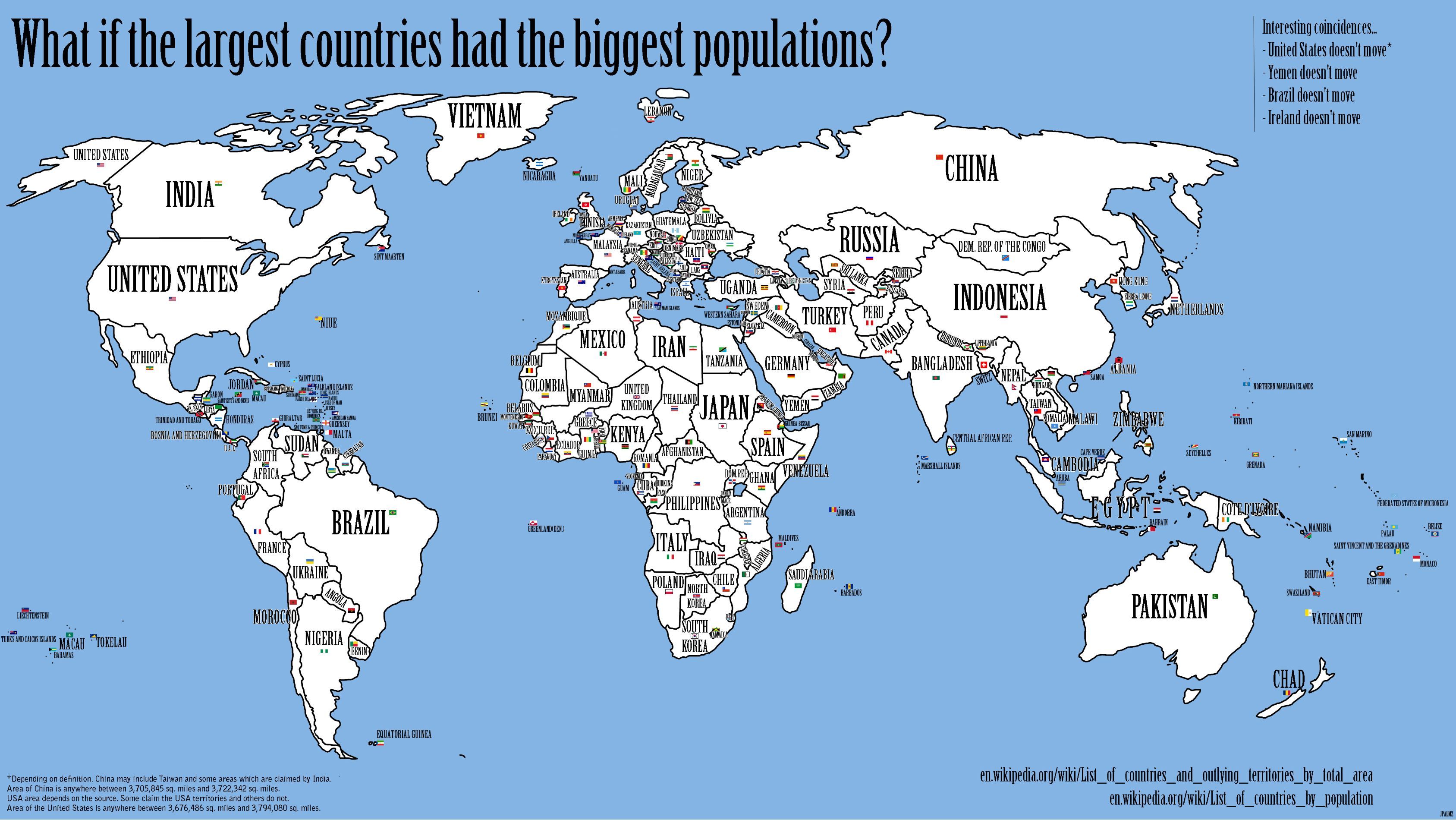
Check out this interesting map from good.is:

See the original here.
The top five in population as it stands today: China turns into Russia, India takes over Canada (which, the authors joke, would make a great arrangement for American companies who outsource technical expertise...), the US stays where it is as the third largest country in both population and land area, Indonesia moves to China, and Brazil stays where it is. Pakistan takes over Australia, and Japan displaces Sudan. Interesting stuff.

When I was born, world population was just under 5 billion. Today, it is almost 7 billion - with some estimates that nearly 99% of that growth takes place in the developing world.

How will we feed everyone? Care for everyone? Where are these people going to go? Already, Indian cities, as well as urban centers in Bangladesh, Pakistan, southeast Asia, sub-Saharan Africa, and Brazil are overcrowded. Around 50% (depends on which estimate you use) of India's population lives below the international poverty line - $1.25 USD a day (even in India, with a relatively low cost of living, that's a mere 55 rupees or less).

Mumbai is a good reminder of what 1.1 billion people really looks like. July 2008.
And bigger questions: how can we foster a world with more people and more perspective? How can longer lives mean more meaningful lives? Can we balance urban development with sustainable outcomes?

Monday, January 10, 2011

the power of one

I'm making good use of a gorgeous snow day in Atlanta by writing a keynote for the Georgia International Leadership Conference in February, and as I run through speech ideas and themes, I came across this video that served as great inspiration in college:

(The Power of One video, courtesy of YouTube)

I'm not sure that I'm qualified to be a keynote speaker on leadership and a global world, but I do know that it takes only one person to create something, to build something. It's up to us to decide what that something is going to be. Whether we lead for better, or for worse. To paraphrase the inauguration speech of President Obama, your people will remember you for what you create, not what you destroy.

Thomas Friedman closes his book The World Is Flat with this, and I will close my speech with the same:
“I can’t tell any other society or culture what to say to its own children, but I can tell you what I say to my own: The world is being flattened. I didn’t start it, and you can’t stop it, except at a great cost to human development and your own future. But we can tilt it, and shape it, for better or for worse. If it is to be for better, not for worse, then you and your generation must not live in fear of either terrorists or tomorrow, of either Al-Qaeda or Infosys. You can flourish in this flat world, but it does take the right imagination and the right motivation. While your lives have been powerfully shaped by 9/11, the world needs you to be forever the generation of 11/9 – the generation of strategic optimists, the generation with more dreams than memories, the generation that wakes up each morning and not only imagines that things can be better but also acts on that imagination every day.”
The power of one is the power to do something.
Anything.

Monday, July 26, 2010

more dreams than memories

walking it out en route to the Taj Mahal (personal photo... please do not reproduce without permission)

This one’s for Ryan -

A few summers ago, I took a long vacation. For many years before that, and ever since then, I haven’t had such an opportunity. It wasn’t a trip for the faint of heart – I spent two months trekking through India and Malaysia with both parents in tow. The trip itself was remarkable, and at the time, much-needed. I was coming off of a very stressful, crazy, and unique year, and only had a few more months to go before graduation. It was my chance to relax, to rediscover pieces of India and pieces of myself, and to do some field research for my two senior thesis papers (one in biomedical engineering on design for the developing world, and one in economics on policy, poverty, and technology in post-1991 India). As such, I picked up The World Is Flat on recommendation from a professor just before I left.

It’s one thing to read a book and understand the context in which it was written. It’s another to experience firsthand, in real-time, that context, and to explore it both intellectually and emotionally. Friedman does an awful lot of writing on things that I’m familiar with – India, economics, development, Georgia Tech – but the most interesting chapter in my eyes was the last. There is a juxtaposition of two dates – 9/11, and 11/9. The former, most in my generation are familiar with as the day that the Twin Towers fell in New York. The latter, equally (or more) important, is the day the Berlin Wall came down and sparked a chain of events that led to the solidification of democracy worldwide (and the eventual opening of the Indian economy in 1991, for those that are interested in my economics research). He then takes these dates and puts them in the context of creation and consumption – of building and destroying. From Friedman:
"[…] then you and your generation must not live in fear of either the terrorists or tomorrow, of either al-Qaeda or Infosys. […] While your lives have been powerfully shaped by 9/11, the world needs you to be forever the generation of 11/9 - the generation of strategic optimists, the generation with more dreams than memories, the generation that wakes up each morning and not only imagines that things can be better but also acts on that imagination every day.”
I was only three on November 11, 1989, but I can imagine that there was a great sense of unity and pride in the world the day that wall came down in Berlin. Friedman goes on to say that what causes people to be driven to extremism and hatred is not a poverty of money, but a poverty of dignity. To see others with opportunities that you yourself have never seen, to live in a world where those opportunities aren’t fathomable, that is a poverty of dignity. The goal of development should not be to create monetary wealth, but rather to create a sense of empowerment, a sense of dignity in a population. When I design a device to be used in a low-resource environment, I’m not trying to give a clinician in Nairobi the same technology that a doctor in New York uses. I’m trying to give them the information they need to make informed choices – on their own. I'm trying to give them tools that are meaningful to them in the context that they live in. I’m trying to give them something to look forward to, to create a dream of how things can be better, not in my eyes, but in theirs.

More dreams than memories, indeed.