Monday, February 28, 2011

a year of blog, a year of dog

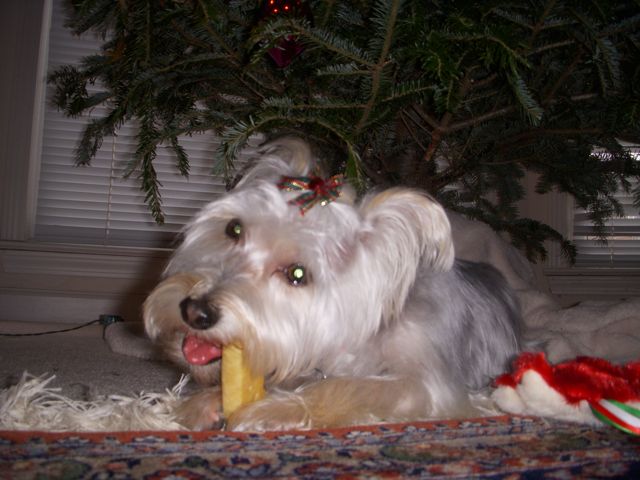
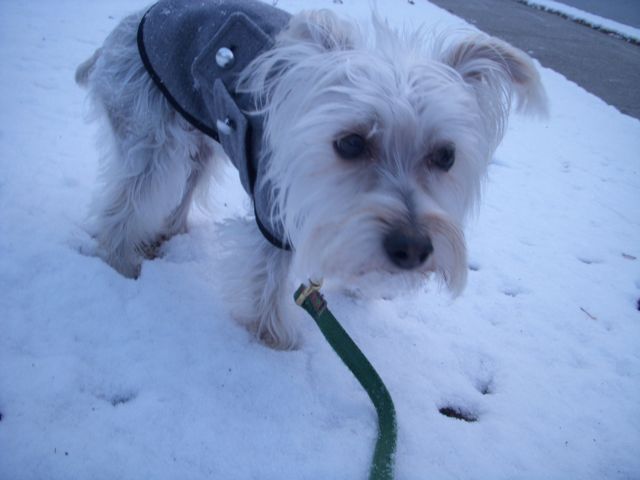
Today is Sawra's first birthday.

It's also been exactly one year since I started this blog. Both experiences have brought me a long way, and have taught me things that I didn't know I needed to learn. For the 2,000-odd visits, emails, comments, and most importantly, conversations, surrounding this blog, I owe immeasurable gratitude to all of you.

Thank you.

And as for puppy, it's hard to describe in words the laughs, the joys, the exasperation, the frustration, and the love of raising your first puppy... so I'll do it in pictures instead :).

Meeting puppy for the first time. Three months old on Memorial Day weekend.
Things Sawra likes: style.
Things Sawra does not like: sunglasses.
Things Sawra likes: displacing me from my bed.
Things Sawra does not like: being displaced from my bed.
Things Sawra likes: clothes (albeit not for the same reasons that I do).
Things Sawra does not like: shoes (or rather, booties, in this case).
Things Sawra likes: Halloween.
Things Sawra does not like: Halloween costumes.
Things Sawra likes: chewing.
... and chewing...
... and chewing.
Things Sawra likes: Aunt Andrea (but then again, who doesn't?).
Things Sawra does not like: cold weather.
If you'd like to use any of these pictures, feel free, with credit.

Sawra is the Aramaic word for "hope." Here's to puppy and the hope of things yet to come.


Happy birthday, puppy!

Sunday, February 27, 2011

creativity & silence

There is a composition by John Cage called 4' 33" (listen here) in which he instructs the entire orchestra to not play a thing during each of the three movements. He came up with the idea when he visited an anechoic chamber, and instead of hearing silence, he heard two sounds: "when I described them to the engineer in charge, he informed me that the high one was my nervous system in operation, the low one my blood in circulation."

He expected silence, but his brain and body filled the space.

The idea here is there is no such thing as the absence of art. Where art is silent, our science finds a way to fill in the blanks and create sounds to plug the silences. Silence gives us room to breathe, to think.

White space is liberating. It creates a gap in which we can think before we respond to the stimulus. It gives us a chance to be creative.

If you want to foster your own creativity, give yourself white space, and see what your mind does with the silence. While it's true that creativity loves constraints, it also needs room to breathe.

The storefront at Victory Sandwich in Inman Park. Love the use of white space in an otherwise "noisy" neighborhood.
Also, a little bragging - major, major kudos to the Vascular Interventions team at Bard Medical - we had our first annual Franchise Awards gig Wednesday, and out of five individual awards and five franchise awards, we took HALF of the total. That's a lot of hardware, and a big deal for a new team. Props!

Thursday, February 17, 2011

good quote, gorgeous day

I love good quotes, and this one's been in my head all week...

(buy the original at quotable)
A 73-degree day in Atlanta that ended with a gorgeous full moon. Saw an old friend at Octane (his music is available on iTunes), finished writing a speech while listening to the cello suites, and came home to a very lick-y puppy and a good book about design and how people are using it to change the world. Life is grand.

Tuesday, February 15, 2011

an open letter to the city of Atlanta and its drivers

Dear City of Atlanta, Metro region, and fellow drivers,

Atlanta, from the west side at Castleberry Hill (shot at dusk with a graduated color filter postprocess... feel free to use with credit)
Like most of y'all, I've grown up in (but wasn't born in) our lovely fair city of sweet tea and Waffle Houses. I've endured the five months of sticky heat every summer, the sporadic snowstorms, the Olympics, a Freaknik or two, a World Series win, a trip to the Super Bowl, and every Peachtree Road Race and Peach Drop in between. I follow all the rules: I avoid Spaghetti Junction between 3:15 and 7 PM (in all directions), stay off the Connector unless it's well past dinnertime, and know better than to try and drive down Peachtree at any point that there might the slightest threat of rain.

Yet despite my almost 10 years of navigating Atlanta roads with the best of them, I'm still at a loss.

I can't seem to figure out why all of the lights on Ponce de Leon are reverse-timed to turn red at inopportune moments on Thursday nights at 11:15 PM (... or why we are still left wondering what causes our smog and traffic problems).

Or why you seem to think that metal plates are viable long-term solutions to potholes on such "remote" thoroughfares such as Piedmont Road and 10th Street.

I'm not sure why Atlanta drivers can treat I-285 like a race at Talladega, but if there are any cars on either side of them, they must drive at the same speed in every lane.

I sure as peaches don't know why I-20 east of the city, all the way to Augusta, is a graveyard for tires, or why everyone drives 80 miles an hour ITP (speed limit: 55) and 60 miles an hour OTP (speed limit: 65).

Or why no one (and I mean, NO ONE) can seem to remember how to drive when the weather is below 45 degrees or there is any chance of any form of precipitation in the forecast.

These are a just a few things I'd like to bring to your attention. Since we have no viable public transportation alternative (before I get an earful from Kearse, we have no viable alternative for anyone that doesn't live and work on a narrow t-shaped path ITP... as in, 98.92% of Metro Atlanta's population), these are just some issues that might be worth considering at some point in the future.

With regards,

An Atlantan

Monday, February 14, 2011

buying stuff with the irrational brain

I just bought a new laptop. This is no small feat, because I've been thinking about the purchase for at least a year now (I bought a new desktop in June instead). There's been a lot of internal (and external) debate about features and benefits and functionality. About Arrandale processors and how many gigs of RAM one needs. About portability.

Sawra approves of the new laptop (feel free to use with credit)
I just finished reading Jonah Lehrer's second book, How We Decide. In it, Lehrer makes an interesting point about purchasing decisions - that when we try and give our prefrontal cortices - our rational centers - too many variables to consider, our brains get overwhelmed and they give up. Our emotional brains have strong reactions to things, and when we're asked to make complicated decisions (like, buying laptops), we really should listen to what our amygdalas are telling us.

Tim Brown once said, "As a designer I ply my craft in the turbulent waters between the complex things we create and the human beings they are intended to serve." Our rational brains are really good at analyzing the complexity of objects that we have, but they are poor predictors of how usable they're going to be in our lives. That's a good challenge for designers to keep in mind - to help people bridge the gap between functionality and usability. Function is rational. Usability is emotional.

A month ago, during Snowpocalypse-turned-Icepocalypse in Atlanta, I impulse-bought the laptop that I should have bought nine months ago. In the month that I've had it, it's barely left my side - from Breckenridge to El Paso to Baltimore and back.

And you know what? It's the best laptop I've ever owned.

Monday, February 7, 2011

things worth dying for are also worth living for

Was catching up with a friend who just returned from several months in Dubai over coffee Sunday (on what's become a rare weekend in Atlanta, as of late), and we got to talking about the happenings in the Middle East. Protests are raging in Egypt, led by a youth movement in a country looking to oust its longstanding President from power.

A protester praying in the street (photo courtesy of... )
It strikes me as strange to think that these protests in Egypt are being led by people my age. Just like those in this country during Vietnam. And those in China during Tiananmen. To think that people would believe so strongly in their cause, at 22, 23, 24. Younger, even. To risk their lives to make a statement. To risk their lives for a reward so sweet as freedom.

These are not trivial sacrifices. The questions are only hypothetical to those of us who are sitting today on this side of our reality.

And so Amira and I asked ourselves, if that was me, if I was there, would I be out in the streets? Would I be protesting? It's easy to sit on this side of the world and say that yes, of course, I would defend my freedoms and stand up for what I believe in, but it's not hard to imagine a world in which people aren't empowered enough to question what they have and don't have. To grow up in a world that allows you to speak your mind. That doesn't block Twitter and censor Wikipedia. In which you don't fear for your life when you choose your friends.

I'd like to think that if I was in that situation I would find something so worth living for that I would die to preserve it.

I can only hope for that kind of courage.

Wednesday, January 26, 2011

what do you give that doesn't cost a thing?

Last month, just after visiting IDEO in Palo Alto, I asked, what is your relationship with money? More important though, is IDEO's question on their facebook group Big Conversations & Small Talk: "What do you give that doesn't cost a thing?"

It makes for good reflection just after the holidays. We give a lot of gifts. We give time. We give experiences & memories. We give hope. We give dreams.

Honesty.

Courage.

Momentum.

Things that don't cost anything.

Monday, January 10, 2011

the power of one

I'm making good use of a gorgeous snow day in Atlanta by writing a keynote for the Georgia International Leadership Conference in February, and as I run through speech ideas and themes, I came across this video that served as great inspiration in college:

(The Power of One video, courtesy of YouTube)

I'm not sure that I'm qualified to be a keynote speaker on leadership and a global world, but I do know that it takes only one person to create something, to build something. It's up to us to decide what that something is going to be. Whether we lead for better, or for worse. To paraphrase the inauguration speech of President Obama, your people will remember you for what you create, not what you destroy.

Thomas Friedman closes his book The World Is Flat with this, and I will close my speech with the same:
“I can’t tell any other society or culture what to say to its own children, but I can tell you what I say to my own: The world is being flattened. I didn’t start it, and you can’t stop it, except at a great cost to human development and your own future. But we can tilt it, and shape it, for better or for worse. If it is to be for better, not for worse, then you and your generation must not live in fear of either terrorists or tomorrow, of either Al-Qaeda or Infosys. You can flourish in this flat world, but it does take the right imagination and the right motivation. While your lives have been powerfully shaped by 9/11, the world needs you to be forever the generation of 11/9 – the generation of strategic optimists, the generation with more dreams than memories, the generation that wakes up each morning and not only imagines that things can be better but also acts on that imagination every day.”
The power of one is the power to do something.
Anything.

Monday, January 3, 2011

goals, resolutions, and the new year

When I was about ten or eleven years old, I was doing a "family tree" project for school. Since I am a first-generation immigrant without the benefit of being surrounded by extended family, my choices for interviews were pretty limited (seeing as my older brother didn't really qualify as an expert on "family traditions and history"). I had written a set of questions to ask my dad, and a few nights before the assignment was due, we were sitting at the kitchen table talking through them.

We were almost done. He had told me stories about his childhood, his parents, about wrecking a car in the garage when he was no more than twelve or thirteen. About coming from a relatively poor family with nine siblings and parents that had retired by the time he started school. About putting himself through college as best he could, and moving to the United States to follow a dream.

The question I asked him was, "What is your greatest accomplishment?"

My father is a successful man. He has built a life for himself and his family - a life that straddles cultures and continents. He has earned a PhD, been tenured at a top-10 school of management in the world, lectured on three continents, started companies. But in that instant, he didn't hesitate. He looked at me without blinking, smiled, and said, "My greatest accomplishment is yet to come."

More than ten years later, I am still in awe of the kind of legacy that my father has left for me. The kind of unflinching resolve to do something better, to be more, than I was this year, this day, this moment. That's the kind of life I hope to design for myself.

Grand Canyon, Arizona - I was there. (feel free to use with credit)
In 2010, I learned to ski. Ran my first 5k (and then my first 10k!). Got a puppy and started a blog. I hiked through the hills of Palm Springs and rafted down the Colorado through the Grand Canyon. Asked tough questions of myself, my friends, my family, and my coworkers. Launched two products. Spearheaded a partnership between Bard and MedShare to donate more than 500 volunteer hours to send medical supplies to the developing world. Flew almost 40,000 miles, deepened friendships, spent more time with my family, and had my first ever white Christmas. It was, to date, the best year of my life.

But just as 2010 was better than 2009, and 2009 better than 2008, 2011 lies ahead of me, and I'm excited. I don't do resolutions, but this I know - my family took some big risks to get where we are. And this year, I resolve to take some big risks myself - personally, professionally, culturally - to make this the best year of my life.

So ask yourself, what goals have you set? What pieces of your past are you calling on to make your future brighter? What risks do you want to take to make this the best year ever?

Sunday, December 26, 2010

designing experiences

When I think about my hometown, there are a few defining experiences that come to mind. Running through Mountain Park on Thursday evenings in the fall, surrounded by the sights and smells of football in the South. Summer nights at Bruster's that seem to stretch on for hours, laughing at jokes that are still funny after retelling them for years. IHOP breakfasts and Ponko lunches. Traffic on Cole Road at 6:45 every January morning.
Sawra enjoying her iced green tea. (feel free to use with credit)
And of course, our Starbucks. We have a beautiful Starbucks that sits out on Lake Lucerne. On clear days, you can watch the ducks playing on the water. At Christmastime, lights shine across the lake, giving it an almost ethereal glow. And on stormy days, the black water will chop at the dock and patio, lending the atmosphere a pensive aura. There isn't a drive through, meaning that everyone that comes by has to stop inside the little shop and say hi. For the past ten years, since I've been able to drive, Starbucks has become a staple of our Lilburn routine. Meeting friends for a cup of coffee, writing a paper for my research project, or having a conversation that changes everything - that Starbucks has played host to a number of memorable moments, in my life and in others.

It's amazing how that atmosphere, that design changes things. Because it's a small shop, because there are only a few well-worn couches and small tables, because there is no drive through, the ambiance inside that Starbucks is far less commercial than any chain coffee shop I've ever been into. The manager once told me that that particular location has one of the highest percentages of "regulars" of any Starbucks in the nation. As for me, three or so mornings a week, I'll stop in for my green tea and vanilla bean scones (you have no idea how good these things are). Patty and Shanna know what my order will be before I get to the counter. I'll say hi to Joe and Greg, and wave at the police officer who has undoubtedly stopped in for a drink before getting on with their shift. The experience of Starbucks has come to mean more than just scones and tea - it's come to mean that I will always walk out in the mornings with a smile.

Today, that Starbucks is closing. The landlord has decided not to renew the lease, and despite being very busy and very profitable, tomorrow, after a beautiful white Christmas in Atlanta, the doors won't open.

The best experiences are the ones that linger for days, weeks after they're over. It's one thing to be able to create that kind of experience with a one-time event - a special outing, a big celebration. It's another to design an environment that consistently leaves people walking out with a smile. I will miss my Starbucks, for sure. Although I may find a replacement for my morning tea and scones, I will not find a replacement for the experience that changed my mornings.